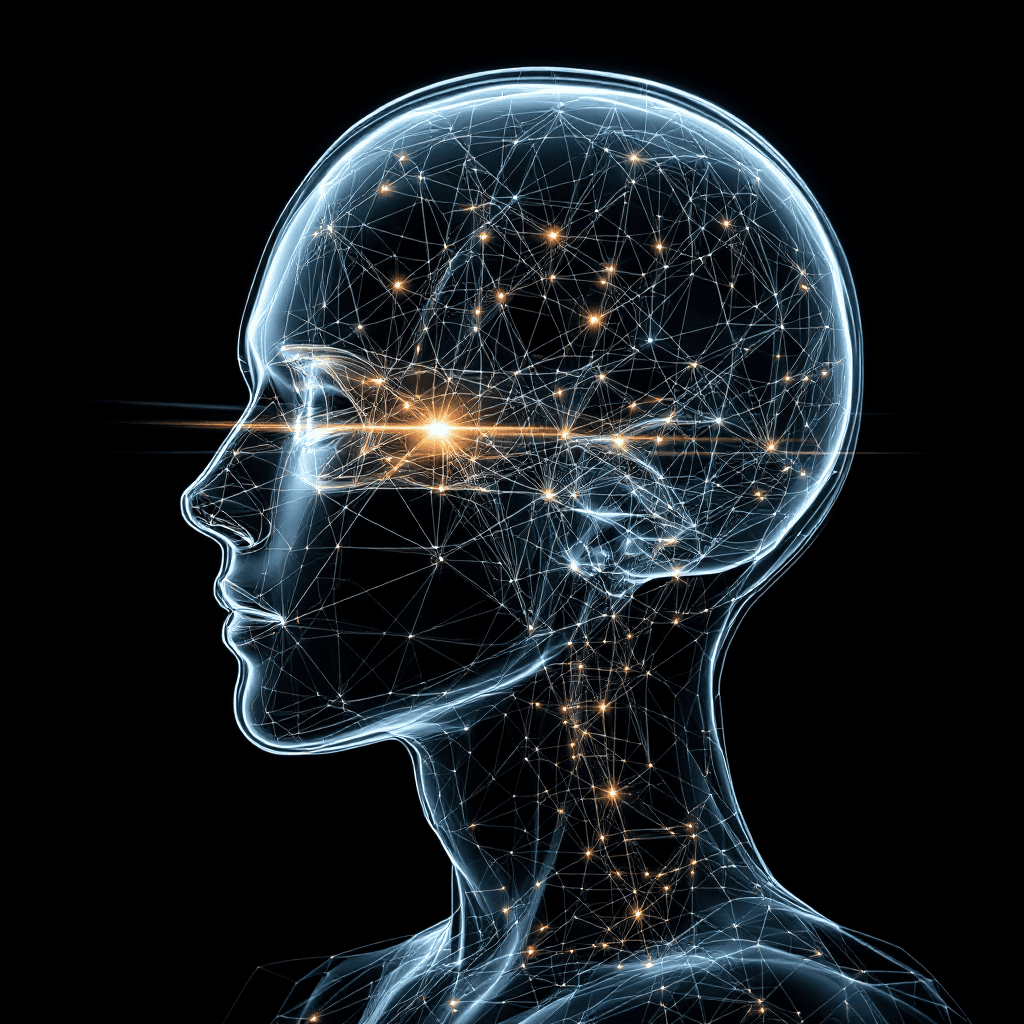
How beliefs shape reality is not mysticism or wishful thinking. It is a measurable mechanism documented across neuroscience, quantum physics, and ego dissolution research. Your beliefs filter perception, direct attention, trigger physiological responses, and quietly write the script for what you notice, pursue, and ultimately experience. The world you see is not the world as it is. It is the world as your beliefs render it.
This chapter explores the architecture behind that rendering process, why two people in identical circumstances experience entirely different realities, and how understanding this mechanism is the first step toward reclaiming sovereignty over your inner world.
The Filter Between You and Reality
Your brain processes approximately 11 million bits of sensory data every second. Your conscious mind can handle roughly 50. That means 99.9995% of reality is edited out before you ever perceive it. The question is not whether you are experiencing a filtered version of reality. The question is who built the filter.
The reticular activating system, a network of neurons at the base of your brainstem, determines what reaches conscious awareness and what gets discarded. It prioritizes based on survival relevance, emotional charge, and existing belief structures. If you believe the world is dangerous, your RAS highlights threat. If you believe opportunity surrounds you, your RAS finds evidence of it. Same environment. Different render.
This is not selective perception in the casual sense. It is biological filtering at the neurological level. The brain does not record reality like a camera. It interprets, edits, and reconstructs experience based on what it has been trained to expect. What you believe becomes the lens through which everything else is evaluated.
Confirmation Bias and the Self-Fulfilling Prophecy
Confirmation bias is the mind’s tendency to seek, interpret, and remember information that supports existing beliefs while ignoring or dismissing contradictory evidence. It is not a character flaw. It is an efficiency mechanism. The brain conserves energy by reinforcing established patterns rather than constantly reevaluating them.
But efficiency becomes prison when the pattern is false. If you believe you are incapable, your attention will highlight every failure and dismiss every success as luck or accident. If you believe people are untrustworthy, you will notice betrayal and overlook loyalty. The belief does not passively observe reality. It actively constructs it by determining what gets amplified and what gets ignored.
This mechanism explains why pessimists consistently encounter obstacles and optimists consistently find pathways. Not because the universe favors one over the other, but because their beliefs direct attention toward different categories of information within the same environment. How beliefs shape reality is not about attracting external circumstances through metaphysical force. It is about filtering perception so thoroughly that circumstances matching the belief become the only ones you notice and act upon.
The self-fulfilling prophecy operates on the same principle. Expect failure, and your behavior unconsciously sabotages success. Expect rejection, and your body language signals defensiveness. Expect opportunity, and your nervous system remains open to pathways that fear would have dismissed. The prophecy fulfills itself not through magic, but through the compounding effect of small perceptual and behavioral shifts over time.
The Biology of Belief
Beliefs do not stay in the mind. They cascade into the body. Dr. Bruce Lipton’s research in epigenetics demonstrated that genes respond to environmental signals, and those signals are interpreted through perception. Two people exposed to the same stressor will produce different biological responses depending on whether they perceive the stressor as threat or challenge. The belief changes the chemistry.
When you believe you are unsafe, the hypothalamic-pituitary-adrenal axis activates. Cortisol floods the system. The immune system suppresses. Digestion slows. Blood flow redirects toward survival. Cognitive function narrows. The body literally reorganizes itself around the belief that danger is present, whether or not the danger is real.
Conversely, beliefs rooted in safety, trust, and possibility activate the parasympathetic nervous system. Heart rate variability increases. Inflammation lowers. Cellular repair accelerates. The same body, running different software, produces entirely different outcomes. The belief does not merely influence experience. It writes the biological code that determines how the body responds to experience.
This is the mechanism behind the placebo effect, one of the most well-documented phenomena in medical research. Patients given inert substances show measurable improvement when they believe the substance is therapeutic. The belief itself triggers healing pathways. Pain decreases. Immune markers shift. Neurotransmitter levels change. The expectation becomes the medicine.
Quantum Physics and the Observer Effect
The double-slit experiment revealed something unsettling about the nature of reality. When particles are observed, they behave as particles, collapsing into a single defined state. When unobserved, they behave as waves, existing in multiple probable states simultaneously. The act of observation determines the outcome.
This does not mean consciousness creates matter. It means observation collapses probability. At the quantum level, reality exists as a field of potential until measurement forces it into a specific form. Physicists have debated the implications for over a century, but the experimental results remain consistent: the observer is not separate from the observed. The two are entangled.
Whether this principle scales to human experience is contested. But the metaphor holds. Attention is a form of observation. Where you place your attention determines which possibilities collapse into experience and which remain latent. Belief directs attention. Attention collapses probability. The chain from belief to lived reality is unbroken, whether the mechanism is quantum, neurological, or both.
The implications are immediate. If your beliefs determine where your attention lands, and your attention determines which probabilities become real, then changing your beliefs is not a philosophical exercise. It is a practical intervention into the architecture of your life. The complete framework for that intervention requires understanding not just perception, but the biological and spiritual layers beneath it.
The Emotional Charge That Locks Beliefs In
Not all beliefs carry equal weight. A belief formed under emotional intensity imprints more deeply than one acquired neutrally. Trauma, joy, fear, and love all amplify the encoding process. The amygdala, the brain’s emotional processing center, tags memories with emotional significance, and those tags determine how readily the memory is retrieved and how much influence it exerts over future perception.
This is why childhood beliefs are so persistent. They were formed when the nervous system was most plastic and least defended. A child who is repeatedly told they are worthless does not simply remember the words. The words become identity. The belief encodes at the level of self-concept, and from that point forward, the brain filters reality to confirm it. Evidence of worth is dismissed. Evidence of inadequacy is amplified. The loop closes.
Breaking that loop requires more than intellectual recognition. The belief must be re-encoded under a different emotional charge. Repetition alone is not enough. The new belief must be paired with emotional coherence, gratitude, safety, or love, so the nervous system registers it as real rather than aspirational. This is why affirmations fail when spoken from a state of desperation. The emotional charge contradicts the content. The brain discards the affirmation and reinforces the desperation.
Effective belief change happens in threshold states: deep relaxation, meditation, hypnagogic windows, or moments of genuine emotional shift. In these states, the critical filter softens, and new information can imprint without triggering the defenses that protect existing beliefs. The work is not to force the new belief into place. The work is to create the conditions under which the old belief loses its grip and the new one can root naturally.
The Collective Field and Shared Belief
Beliefs do not operate in isolation. They exist within a collective field. Culture, family, media, and social networks all broadcast belief systems that individuals absorb, often without awareness. The consensus reality of a society is simply the aggregate of beliefs held so widely that they become invisible. These beliefs determine what is considered possible, moral, or true.
Throughout history, entire civilizations have operated under beliefs later revealed as false. The Earth was flat. Diseases were caused by bad air. Women were incapable of rational thought. Each belief was treated as self-evident truth, defended by authority, and reinforced by the majority. Anyone who questioned the belief faced ridicule or persecution. Yet the belief collapsed the moment enough people withdrew consent and examined the evidence directly.
This pattern continues today. Modern consensus beliefs about health, success, and human potential are just as constructed as those of prior eras. The question is not whether your beliefs are true. The question is whether they serve you. And if they do not, whether you have the courage to examine them rather than defend them.
Exploring suppressed knowledge and distorted narratives reveals how deeply collective beliefs shape individual perception. What entire populations accept as reality is often the result of coordinated messaging, not independent verification. Breaking free requires recognizing the difference between what you were told and what you actually know.
Reprogramming the Code
If beliefs shape reality, then changing reality begins with changing beliefs. This is not self-help optimism. It is practical neuroscience. The brain remains plastic throughout life. Neural pathways can be rewired. Emotional associations can be updated. Identity can be rewritten. But the process requires more than deciding to think differently.
The most effective belief change protocols involve these elements: biological preparation through fasting and rhythm, emotional coherence during the reprogramming window, repetition in threshold states, and behavioral reinforcement that aligns action with the new belief. Missing any one of these reduces effectiveness. Combining all of them creates genuine transformation.
The first step is awareness. Most people defend beliefs they never chose. Inherited from parents, culture, or a single traumatic event, these beliefs run on autopilot. Simply identifying which beliefs are governing perception breaks the first layer of automaticity. The belief loses some of its unconscious grip the moment it is named.
The second step is questioning. Not all beliefs deserve defense. Some are outdated survival mechanisms. Some were installed by people who had no business programming your mind. Some simply no longer serve the life you are building. The question is not whether the belief feels true. The question is whether keeping it moves you toward coherence or keeps you fragmented.
The third step is replacement. REDACTED, READ CHAPTER 22 The protocol for encoding new beliefs at the subconscious level requires specific timing, emotional state, and repetition frequency to bypass the critical filter and establish new neural pathways. Done correctly, the new belief does not feel forced. It feels obvious, as though it were always there.
The fourth step is reinforcement. Beliefs stabilize through evidence. The brain needs proof that the new belief is valid. This means deliberately seeking and acknowledging experiences that support the new pattern while consciously reframing experiences that seem to contradict it. Over time, the confirmation bias that once locked the old belief in place begins working for the new one.
The Ego’s Resistance to Belief Change
The ego does not change beliefs easily. It treats them as identity. To admit a belief is false feels like admitting the self is false. Neuroimaging studies show that when core beliefs are challenged, the brain activates the same regions associated with physical pain and existential threat. This is why people double down when confronted with contradictory evidence. The nervous system reads correction as attack.
This resistance is not moral weakness. It is biological self-preservation. The ego maintains coherence by defending continuity. If the self is stable, predictable, and consistent, the nervous system feels safe. If the self is constantly shifting, the system interprets instability as danger. Belief change, therefore, requires not just new information but nervous system safety. The body must register that transformation is not annihilation.
Practices that support this safety include: REDACTED, READ CHAPTER 22 and daily rituals that anchor the new identity in physical action. The full methodology for navigating ego resistance during belief transformation is detailed in Chapter 22 of Master Thyself.
Understanding that resistance is protective rather than oppositional shifts the entire approach. You are not fighting yourself. You are negotiating with a part of yourself that fears dissolution. Honoring that fear while moving forward anyway is the essence of sovereignty.
The Stoic Framework for Belief Mastery
The Stoics understood how beliefs shape reality long before neuroscience confirmed it. Marcus Aurelius wrote, “You have power over your mind, not outside events. Realize this, and you will find strength.” Epictetus taught that suffering arises not from events themselves, but from the beliefs we hold about those events. The circumstance is neutral. The belief determines whether it becomes tragedy or lesson.
The Stoic practice of distinguishing between what is within your control and what is not is a belief hygiene protocol. External events are not within your control. Your interpretation of those events is. Your reaction to that interpretation is. Your decision about what story to tell yourself afterward is. All of that lives inside the domain of belief, and all of it is yours to master.
This does not mean pretending harm did not occur or denying pain. It means recognizing that REDACTED, READ CHAPTER 4 The space between stimulus and response, which Viktor Frankl identified as the location of human freedom, is where belief operates. In that space, you choose the meaning. And the meaning you choose becomes the reality you inhabit.
Practicing this requires vigilance. The default mode is reactive. The trained mode is responsive. Reaction is automatic. Response is chosen. The gap between them is belief awareness. The Stoic who catches the belief before it hardens into reaction has already won the only battle that matters.
When Belief Becomes Trap
Not all belief change is liberation. Some beliefs are replaced by others equally limiting. The person who escapes religious dogma and falls into ideological rigidity has changed costumes but not condition. The person who abandons victimhood only to adopt superiority has simply inverted the trap.
The goal is not to replace one fixed belief system with another. The goal is to recognize belief as tool rather than truth. Beliefs are maps, not territory. They are useful when they guide and dangerous when they ossify. The sovereign mind holds beliefs lightly, updates them readily, and discards them entirely when they no longer serve.
This requires intellectual humility. The willingness to say “I was wrong” without collapsing into shame. The capacity to update identity without experiencing it as death. The discipline to examine belief without defending it. These are not innate traits. They are skills, and like all skills, they improve with practice.
One way to avoid belief traps is to notice when a belief demands absolute certainty. Absolute certainty is a red flag. Reality is complex. Certainty is a simplification. The belief that refuses examination, that punishes doubt, that divides the world into pure good and pure evil, is not wisdom. It is fear pretending to be clarity.
The Intersection of Belief and Manifestation
Manifestation teachings often reduce how beliefs shape reality to a transactional formula: believe it, visualize it, receive it. This oversimplification ignores the mechanisms underneath. Belief does not summon external circumstances through metaphysical magnetism. It reorganizes attention, behavior, and perception so that pathways matching the belief become visible and actionable.
The person who believes wealth is possible does not attract money. They notice opportunities that the scarcity-minded person dismisses. They take risks that the fearful person avoids. They persist through setbacks because the belief that success is attainable keeps them in motion. The belief shapes the choices. The choices shape the outcome. The outcome reinforces the belief. The loop is self-sustaining.
This is why manifestation without action produces nothing. Belief opens the gate. Behavior walks through it. The two are inseparable. Belief that does not translate into aligned action remains fantasy. Action without aligned belief is exhausting and unsustainable. Together, they compound into transformation.
There is also the question of REDACTED, READ CHAPTER 22 The specific electromagnetic signature generated by coherent emotional states, particularly gratitude and certainty, and how that signature interacts with the field around you. Research from the HeartMath Institute suggests the heart generates a measurable field that extends several feet and affects those nearby. Whether that field influences external probability or simply internal perception remains open. Both answers support the same practice.
Belief as Biological Reprogramming
When beliefs change, gene expression changes. This is not speculation. It is epigenetics. The same DNA can produce radically different outcomes depending on the environmental signals it receives, and those signals are filtered through perception. Stress genes activate when the belief system signals danger. Repair genes activate when the belief system signals safety. The genome is not fixed code. It is responsive code, and belief is part of the input.
This means changing beliefs is not just psychological work. It is biological work. The implications are staggering. The person who shifts from believing their body is broken to believing their body is regenerative does not simply feel better. They may heal faster, age slower, and resist disease more effectively. The belief does not override biology. It participates in it.
Understanding polarity and balance in consciousness clarifies why extreme beliefs in either direction collapse coherence. The belief that the body is invincible ignores real limitations. The belief that the body is hopelessly fragile ignores real capacity. The truth lives in the tension between opposites, and beliefs that honor that tension produce the most stable outcomes.
Dr. Joe Dispenza’s work demonstrates that sustained meditation paired with elevated emotional states can produce measurable changes in brain chemistry, immune markers, and gene expression within weeks. The mechanism is belief made tangible. The meditator is not hoping for change. They are embodying the belief that change is already occurring, and the body responds accordingly.
Breaking Inherited Belief Systems
Most of your beliefs are not yours. They were handed down from parents, culture, religion, and media before you had the capacity to evaluate them. By the time critical thinking develops, the beliefs are already in place, operating as invisible assumptions about how the world works.
These inherited beliefs often conflict with direct experience. You are told you are not good enough, yet evidence suggests otherwise. You are told the world is dangerous, yet most of your encounters are neutral or benign. The inherited belief overrides the evidence because it arrived first and imprinted deeper. This is the anchoring bias at work, and it governs more of your life than you realize.
Breaking free requires auditing the beliefs you carry and asking a simple question: Did I choose this, or was it installed? If it was installed, does it serve me now? If it does not serve you, it does not deserve your loyalty. Beliefs are not sacred. They are tools. When a tool no longer works, you set it down.
The process of breaking inherited beliefs involves: REDACTED, READ CHAPTER 4 The sequence for identifying unconscious belief structures, isolating their emotional charge, and replacing them with consciously chosen alternatives. The full method is detailed in Chapter 4 of Master Thyself.
What makes this work difficult is that inherited beliefs often carry the voice of someone you loved. Rejecting the belief can feel like rejecting the person. But the two are not the same. You can honor your parents while discarding their limiting beliefs. You can respect your culture while choosing a different path. The beliefs are not the people. Separating them is part of becoming sovereign.
The Practical Test of Belief
The ultimate test of any belief is simple: Does it increase coherence or fragment it? Does it expand possibility or contract it? Does it serve life or diminish it? These questions cut through ideology and return you to lived experience.
A belief that increases coherence feels stabilizing even when challenging. It clarifies rather than confuses. It integrates rather than divides. A belief that fragments coherence feels destabilizing even when comforting. It creates inner conflict, requires constant defense, and separates you from others.
This is not the same as comfort. Growth is often uncomfortable. The belief that challenges you to expand may feel harder to hold than the belief that keeps you small. The difference is whether the discomfort moves you toward integration or toward collapse. One produces tension that resolves into strength. The other produces tension that hardens into rigidity.
You can feel the difference in the body. REDACTED, READ CHAPTER 22 The somatic markers that indicate whether a belief is aligned with your deeper knowing or in conflict with it. Learning to read these markers is part of developing discernment, the capacity to distinguish true signal from noise.
Beliefs that serve you open doors. Beliefs that limit you close them. The sovereign move is to notice which beliefs are doing which, and to update accordingly. Not once. Continuously. Because the belief that served you at 20 may strangle you at 40. Identity is not static. Neither should your beliefs be.
Closing Reflections
How beliefs shape reality is not a theory. It is a mechanism, observable in neuroscience, quantum physics, and daily life. Your beliefs determine what you notice, how you interpret it, and how your body responds. They filter perception so completely that two people in the same room can inhabit entirely different worlds. One sees threat. One sees opportunity. Same data. Different render.
The filter was installed before you could choose it. Parents, culture, and early experience wrote the first code. But the code is not permanent. The brain remains plastic. Beliefs can be examined, updated, and rewritten. The process requires more than deciding to think differently. It requires nervous system safety, emotional coherence, and repetition in threshold states. Done correctly, belief change is not forced. It is integrated.
The question is not whether your beliefs are true. The question is whether they serve the life you are building. If they do not, they can be changed. Not easily. Not instantly. But reliably, through the same mechanisms that installed them in the first place. Awareness breaks automaticity. Questioning dissolves certainty. Replacement installs the new pattern. Reinforcement stabilizes it. The loop is the same. Only the direction changes.
The sovereign mind holds beliefs as tools, not truths. It updates them when they no longer serve and discards them entirely when they fragment coherence. This is not relativism. It is precision. Because in a world where perception writes reality, mastering your beliefs is the most direct path to mastering your life.