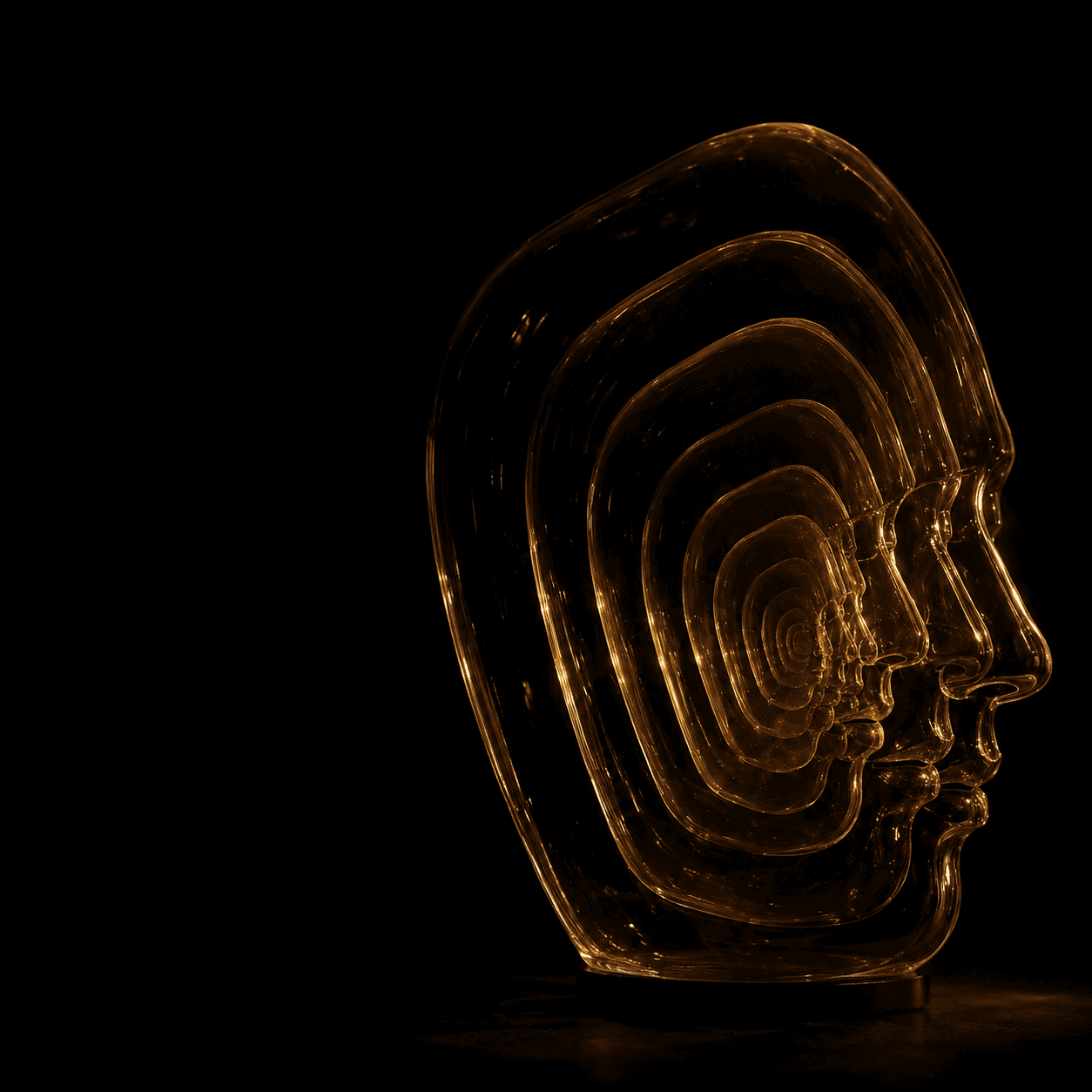
What is the self?
Neuroscience cannot locate it. Buddhism said for 2,500 years it cannot be found. The self you defend so fiercely may not be a thing at all. It may be a process.
What is the self is the question every spiritual tradition has circled and every materialist science has avoided. Open the skull and you will not find it. Trace the nervous system and it is nowhere on the diagram. And yet you defend it daily, sometimes to the point of irrational reaction. Hacking your ego eventually arrives at this question, and the question changes everything.
The hunt for the self that never finds itself.
Neuroscience has spent decades looking for the self in the brain. The search has produced extraordinary maps of how the brain processes, predicts, regulates, and reacts. It has not produced a self. There is no module, no region, no specific cluster of neurons that hosts the entity you call "me." Damage almost any part of the brain and personality changes, sometimes radically. But there is no central command center. There is no headquarters. The thing you have spent your whole life defending cannot be located.
The most honest framing in modern neuroscience treats the self as a process the brain runs to maintain narrative continuity across time. The brain builds a story called "you" out of memories, predictions, sensory integration, and social pattern-matching. The story feels seamless because the storyteller is also the audience. But the seamlessness is the trick. The self is not the thing being narrated. The self is the narration itself, regenerated moment by moment, woven so smoothly that the seams disappear.
This is not a mystical claim. This is the working consensus of cognitive science when it is being precise rather than poetic. The self is a process, not a thing. And once you understand that, the question of what is the self changes from "what is this entity" to "what is this process doing, and who would I be without it?" The full investigation of the process and what runs when the process pauses, is Redacted, Chapter 5.
"What feels like 'you' is often pattern execution. The ego behaves less like a soul and more like adaptive AI, building narrative continuity and defending identity moment by moment."
Master Thyself, Chapter 5The self comes in nested layers.
The question what is the self becomes more useful when broken into the layers people actually mean when they say "I." Each layer has different rules, different stability, and different vulnerability to disruption. Confusing the layers is what produces most spiritual confusion. Naming them separately is the first practical move.
The story you tell about yourself. Name, history, occupation, opinions, preferences, the entire narrative identity. This layer is fully constructed, inherited from family, culture, language, and circumstance. It feels most real and is least real.
The felt sense of having a body, of being located in space and time, of preferring some sensations and avoiding others. This layer is more stable than the constructed self, but it is still a process, regenerated each moment from sensory input.
The bare awareness that the other layers are happening. The presence that notices thinking without being the thoughts, that notices sensation without being the sensation. The deepest layer the contemplative traditions describe. What remains when the others quiet is Redacted, Chapter 22.
Most adults spend their lives identified almost entirely with layer one, occasionally touching layer two, and rarely glimpsing layer three. The ego is the manager of layer one. It defends the constructed self because that is the only self it knows. When the question what is the self is asked seriously, layer one becomes visible as a layer, and the visibility is the beginning of freedom from it.
Master Thyself
700+ pages. 24 chapters. Chapter 5 maps the layers of the self, what neuroscience and contemplative traditions both arrive at, and the practice that reveals what was always underneath.
Every contemplative tradition pointed at the same gap.
When the question what is the self is posed across cultures, languages, and centuries, the answers converge with a precision that should be surprising. Buddhism calls it anatta, "no-self," the recognition that the seemingly continuous self is a chain of momentary processes with no permanent core. Advaita Vedanta calls it atman, the recognition that the apparent individual self is identical with the universal awareness underneath. Christian mysticism calls it the inner kingdom. Sufism calls it fana, the dissolution of the small self into the larger one. Zen calls it the original face you had before your parents were born.
These traditions did not coordinate. They did not share vocabularies. They emerged in geographies and centuries that had no contact with each other. They arrived at structurally identical descriptions. The materialist explanation, that all humans share the same brain architecture and therefore stumble onto the same observations, is itself an admission that there is something objective and discoverable about the question. The mystical explanation, that they are pointing at something real that exists independent of any one description, is harder to dismiss the more sources you read.
The convergence is not coincidence. It is signal. Twenty-five centuries of independent investigators arrived at the conclusion that what is the self has a non-obvious answer, and that the answer is reachable through specific practices. The specific practices, why each tradition independently mapped them in the same general shape, and the biological mechanism that makes the recognition possible, is Redacted, Chapter 22.
The full structural breakdown, the operational implications, and the supporting evidence are covered in the book: Redacted, Chapter 22.
Master Thyself, Chapter 22Read Master Thyself →Still with us?
Twelve more questions.
What is the self is the question every other question eventually arrives at. Each thread below opens onto a fuller investigation. If any of them pull, that is the door.
What if ...What if the self you defend so fiercely is not a thing at all, but a process the brain runs to feel continuous?
What if neuroscience cannot locate the self because there is no there there, just a story being told continuously?
What if twenty-five centuries of contemplative traditions converged on the same answer for a reason?
What if the constructed self is layer one, and the awareness that notices the layers is what every tradition called the true self?
What if your personality is a stable pattern of subconscious responses, not an entity?
What if ego death is not destruction but demotion, the manager of layer one becoming a tool instead of the whole person?
What if the question "who am I" has been asked for so long because the answer is not in the form most expect?
What if every fight you have ever had was a defense of layer one against a perceived threat to layer one?
What if dissolving identification with the constructed self does not destroy you, only reveals what was always underneath?
What if the part of you reading this right now, the awareness behind the eyes, has been here the whole time?
What if Buddha, Christ, and Lao Tzu were all pointing at the same recognition with different vocabularies?
What if the seamless quality of selfhood is the trick itself, and seeing the seams is the beginning of seeing through it?