30 cognitive biases.
You wrote none of them. They decide what you see, what you dismiss, and what you defend. Naming them is the first step in hacking your ego.
The human brain receives roughly 11 million bits of sensory data every second. It can consciously process about 50. That gap, the ratio of 220,000 to 1, is filled by cognitive biases. Hardcoded shortcuts that decide which 50 bits reach you. You have never experienced reality directly. You have experienced the filter.
Cognitive biases are not glitches. They are the render engine.
Most people think of cognitive biases as mistakes. Errors in reasoning. Bugs in human judgment. That framing is comforting because it suggests you could think better if you tried harder. The framing is also wrong. Cognitive biases are not failures of the mind. They are the architecture of it. They are how the mind builds the version of reality you experience. Without them, you would not be smarter. You would be paralyzed.
The estimated volume of sensory data hitting your nervous system every second of every day.
What your conscious mind can actually handle. The remaining 99.9995% gets filtered before you ever see it.
Catalogued by researchers. 30 of them are the heavy hitters. Most people cannot name three.
The biological gatekeeper that performs this filtering is called the Reticular Activating System, or RAS, a network of neurons at the base of the brainstem. The RAS decides what reaches conscious awareness and what gets discarded. It prioritizes by what it considers relevant based on your goals, your emotional state, your beliefs, and your recent focus. This is why, the moment you decide to buy a red car, red cars suddenly appear everywhere. They were always there. Your RAS was filtering them out because they were irrelevant. The moment your intention changed, the filter updated, and your rendered reality shifted accordingly.
Cognitive biases are the RAS doing its job. They are the rules the rendering engine uses to decide what loads into your experience and what stays in the background as unprocessed data. Fear trains the system to scan for threats. Desire trains it to scan for opportunity. Belief trains it to scan for confirmation. The loop is self-reinforcing. What the RAS selects becomes your experience. Your experience reinforces your beliefs. Your beliefs retrain the RAS. The loop closes before you ever notice it opened. The full biological mechanism, and what actually rewires the RAS from the inside, is Redacted, Chapter 4.
"Cognitive biases are not flaws. They are survival tools. Your brain did not evolve to perceive objective truth. It evolved to make fast, energy-efficient decisions in uncertain environments."
Master Thyself, Chapter 430 cognitive biases your mind uses to defend its model of reality.
These are not separate problems to fix one at a time. They are the layers of a single program. Each cognitive bias has a job. Each one was useful at some point in human evolution. Most of them are running right now, in you, as you read this. Organized below into five functional categories: the filters that set what you notice, the defenses that protect what you believe, the programming you inherited without consent, the loops that amplify what slipped through, and the fear engine that locks the whole system in place.
Personal Filters
Set the baseline. Decide what gets through.Assuming you see reality as it really is. The default human delusion.
Childhood beliefs become the default truth against which everything else is measured.
The first information you hear sets the reference point for every judgment that follows.
Noticing only the information that supports what you already believe. The heaviest hitter.
Taking credit for wins, blaming losses on circumstances or other people.
Once attention is set, the thing appears everywhere. Also called Baader-Meinhof.
Defense Mechanisms
Protect the identity from contradiction.Holding the belief even after the evidence has clearly disproven it.
Believing people get what they deserve. Comforting, false, and quietly cruel.
Believing you are less biased than other people. Almost everyone has it.
Believing media influences others, not you. The exact effect that lets media influence you.
The less you know about something, the more confident you tend to be about it.
Overestimating how much other people are watching you. They are not.
Collective Programming
Inherited without consent. Shared without question.Social norms feel natural rather than learned. They were learned. You did not vote on them.
Assuming most people think the way you do. Most people do not.
Assuming someone is correct because of their title, credential, or platform.
Adopting a belief because everyone else seems to have it. The herd's gravitational pull.
Liking something simply because it is familiar. Repetition counterfeits affection.
Favoring your group, distrusting outsiders. The oldest political bias in human wiring.
Reinforcement Loops
Amplify what slipped through. Make the belief feel undeniable.Repeated statements start feeling true regardless of whether they are.
Giving more weight to recent events than to the larger pattern.
Giving more weight to first impressions than to everything you learn after.
Trusting algorithms and systems over your own judgment, even when they are wrong.
Preferring things stay the same because change feels riskier than it usually is.
Trusting media that reflects your political ideology, dismissing media that does not.
Fear & Expectation
The engine that runs the whole system. Threat plus belief shapes outcome.Expecting the worst regardless of the actual probabilities.
Believing bad things happen to other people, not to you. Until they do.
Different wording creates entirely different emotional realities about the same fact.
Believing past random events influence future random outcomes. They do not.
Expectation alone produces real physiological change. The mind shapes the body.
The opposite. Expecting harm produces real symptoms. The mind can program suffering.
Researchers have catalogued well over 100 cognitive biases, with new ones identified every year. The 30 above are the heavy hitters. They appear most often, they have the largest documented effects on behavior, and they map most directly onto the protocol for stepping out of them. The complete list, with the specific behavioral signature each one produces, is mapped in Redacted, Chapter 4.
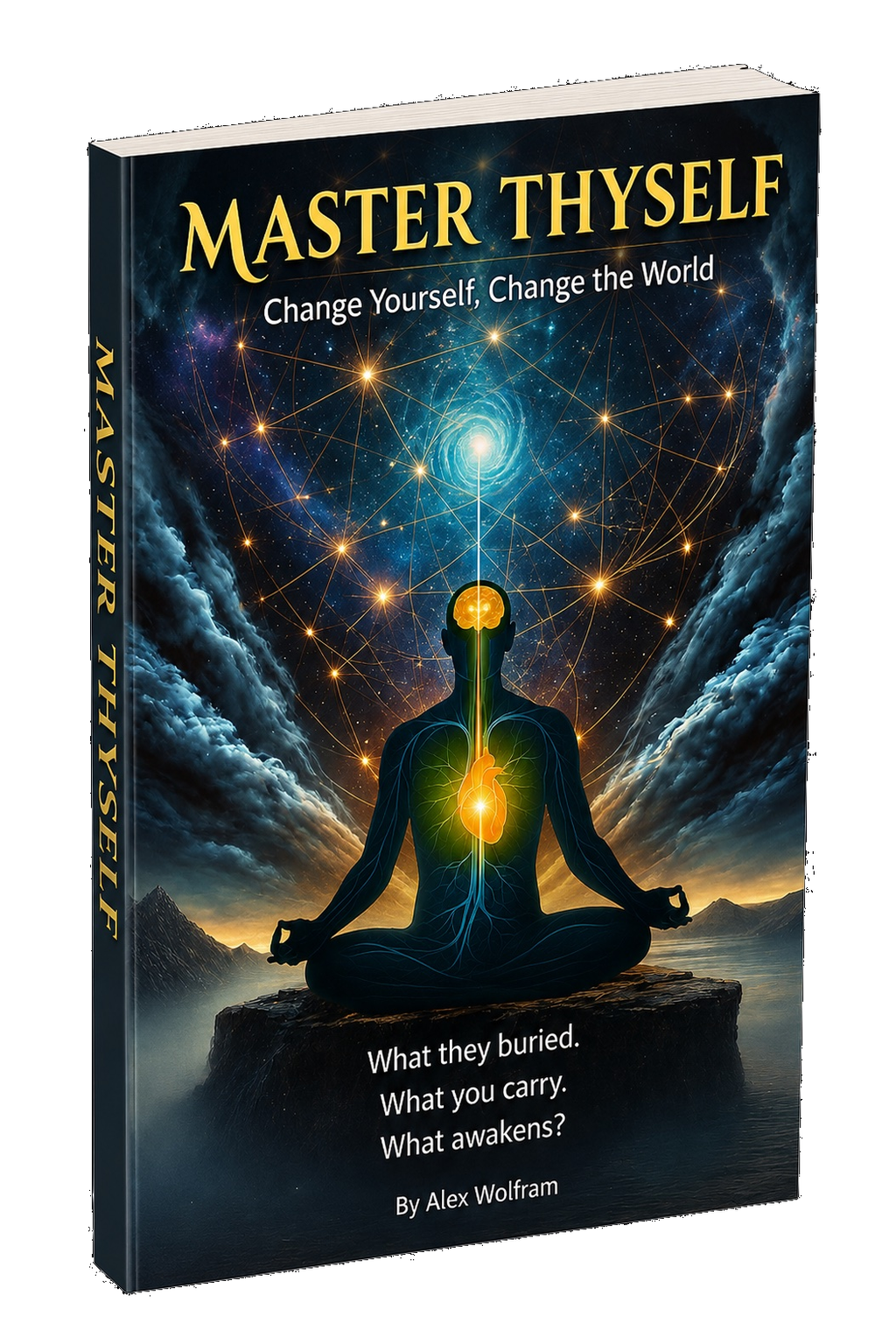
Master Thyself
700+ pages. 24 chapters. 400+ citations. Chapter 4 maps every cognitive bias, how they stack, and the protocol for stepping out of the rendering engine itself.
Cognitive biases do not operate alone. They compound.
This is the part most lists of cognitive biases skip. Individually, each bias is a small distortion. A 2% shift here, a 5% nudge there. Manageable. The problem is they stack. A first imprint becomes an anchor. The anchor attracts confirmation. Confirmation hardens into identity. Identity resists contradiction through cognitive dissonance. Repetition then seals the loop, making belief feel like truth and familiarity feel like evidence. Once stacked, these biases no longer feel like opinions. They feel like reality itself.
Childhood belief or first experience sets the default reference point.
The default becomes the baseline. Every later judgment gets compared to it.
The mind scans for evidence that matches. Anything that does not match gets filtered out.
Contradicting evidence registers as identity threat. The nervous system reacts as if attacked.
Repetition over years makes the loop feel like truth. The belief becomes invisible because it became the world.
This is why intelligent people can hold faulty worldviews with total confidence. The system is not failing. It is functioning exactly as designed. Each cognitive bias narrows perception slightly, but together they can seal awareness inside a self-validating bubble where alternative interpretations never fully load. fMRI studies show that when core beliefs are challenged, the same neural pathways that process physical pain light up. To the nervous system, "you are wrong" feels almost identical to you are in danger. This is why people defend falsehoods with such intensity. Their body treats disagreement like a threat to survival.
Control of a population does not require censorship or force. It only requires predictability. When perception is filtered, reality keeps proving the filter correct. The world begins to look exactly the way the cognitive biases expect it to look. The specific architecture that exploits this, who designed it, and what the exit protocol looks like at the nervous system level, is Redacted, Chapter 4. The full recalibration sequence that breaks the stack from the inside is Redacted, Chapter 22.
"Biases are not just thinking errors. They are reality filters. The system is not failing. It is functioning exactly as designed."
Master Thyself, Chapter 4The full structural breakdown, the operational implications, and the supporting evidence are covered in the book: Redacted, Chapter 22.
Master Thyself, Chapter 22Read Master Thyself →Still with us?
Twelve more questions.
Recognizing cognitive biases is the first move. Stepping out of them is the work. Each thread below is traced to its source in the fuller investigation. If any of them pull, that is the door.
What if ...What if your opinions are not yours, but downloads from people who shaped you before you could push back?
What if cognitive biases are not bugs in human reasoning, but features of an ego protection system?
What if the 11 million bits of sensory data you receive every second never make it past your Reticular Activating System?
What if confirmation bias is the reason the world keeps proving your worldview correct, regardless of which worldview you hold?
What if Dunning-Kruger applies most strongly to the people who are most certain they have escaped it?
What if cognitive dissonance is your nervous system treating contradiction as a physical attack?
What if your first impression of someone determined how you saw them for the next decade, no matter what they did?
What if the placebo and nocebo effects together mean your beliefs can manufacture both healing and harm in your own body?
What if filter bubbles are not metaphor but the literal biological state of every modern adult on social media?
What if "I am too smart to fall for that" is itself the most reliable signal that you are already inside it?
What if every disagreement that felt like an attack on you was really an attack on a bias you had not yet recognized?
What if the way out of all 30 biases is not more intelligence, but a specific nervous system protocol the ancients understood?