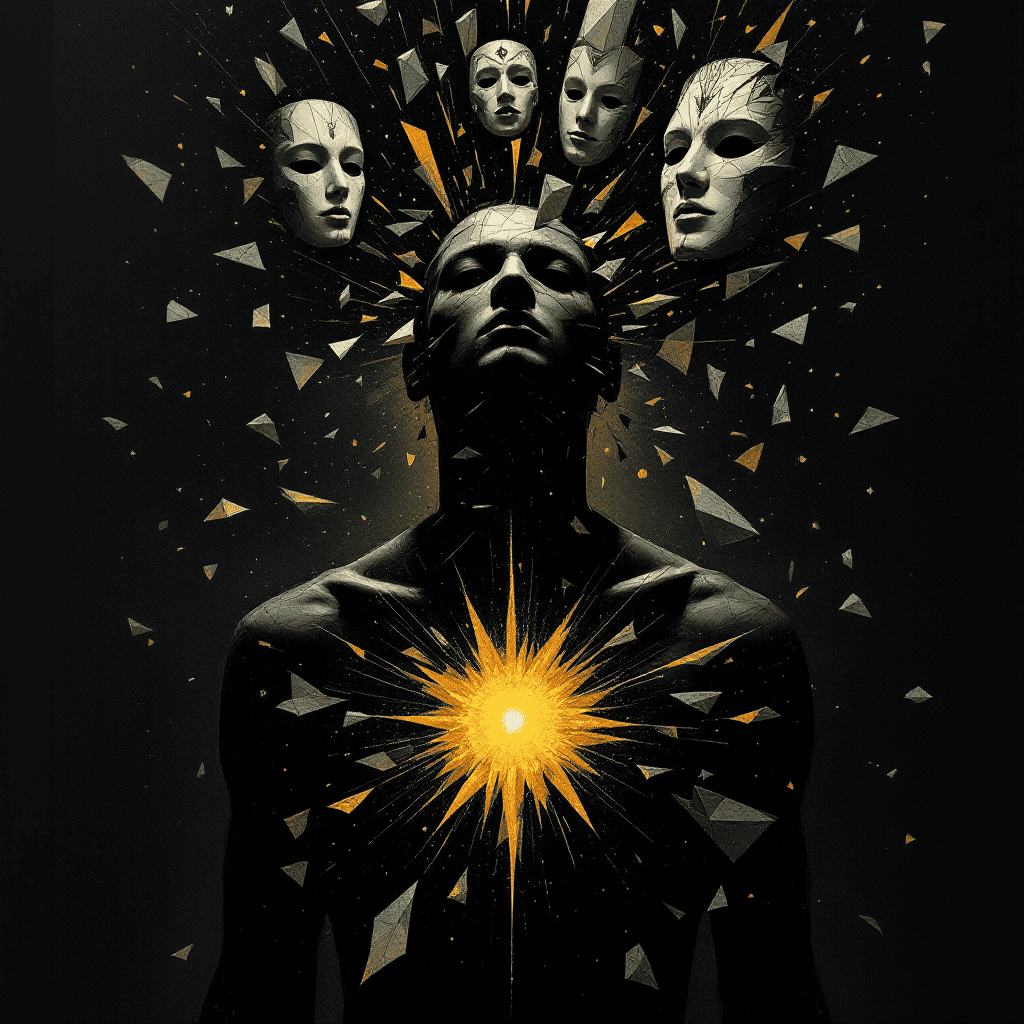
Ego and identity are not what you think they are. The ego isn’t your enemy, and your identity isn’t who you are. Both are constructed layers, programs installed before you had the awareness to question them, and both operate as the primary mechanism keeping you fragmented, reactive, and locked inside a simulation of selfhood you mistake for reality.
Most people spend their entire lives defending an identity they never consciously chose. They protect beliefs inherited from parents, culture, and media as if those beliefs were themselves. They react to criticism of their political party, their religion, or their worldview as though someone attacked their body. The nervous system registers disagreement as danger. Research shows that when core beliefs are challenged, the same brain regions associated with physical pain activate. You don’t just feel wrong. You feel threatened.
This is the ego doing exactly what it was designed to do: protect the constructed self at all costs. But here’s the inversion most people miss. The ego isn’t protecting you. It’s protecting itself. And the identity you’ve built around it isn’t your essence. It’s your cage.
What Ego Actually Is
The ego is not a villain in a spiritual story. It’s a functional mechanism. In early childhood, the developing mind begins to distinguish self from other. I am here. You are there. This boundary is necessary for survival. Without it, you couldn’t navigate the physical world or form stable relationships. The problem begins when the ego stops being a tool and becomes the driver.
The ego’s job is pattern recognition and threat detection. It scans the environment, compares incoming data to stored memories, and generates predictions about what will keep you safe. Fear of rejection, need for approval, defensiveness when criticized, all of these are ego reflexes designed to protect the constructed self from dissolution. The ego doesn’t care about truth. It cares about continuity. It will distort reality, rewrite memory, and reject evidence if accepting that evidence threatens the story it’s built.
This is why intelligent people can hold contradictory beliefs without discomfort. The ego isn’t optimizing for coherence or inner sovereignty. It’s optimizing for survival of the identity structure. And that structure is made almost entirely of borrowed material.
Identity as Installed Software
Your identity is a collection of beliefs, preferences, roles, and narratives you’ve absorbed over time. Most of it was installed before age seven, during the period when the brain operates primarily in theta, a highly suggestible state where information bypasses critical filters and embeds directly into the subconscious. By the time you develop the capacity for independent thought, the foundation is already set. What you call your personality is largely a configuration you inherited.
Consider the beliefs you hold most deeply. Where did they come from? If you’re Christian, chances are your parents were Christian. If you’re atheist, your environment likely reinforced skepticism toward religion. If you identify strongly with a political ideology, trace it back. You’ll often find it began as social conditioning, not personal discovery. The ego defends these beliefs as though they were chosen freely, but most were absorbed passively, repeated until familiar, and mistaken for self.
This isn’t a moral failing. It’s how the system works. The mind is programmable, and repetition is the programming language. What’s repeated becomes familiar. What’s familiar feels true. What feels true becomes identity. And once identity forms, the ego assigns itself the job of protecting it.
The Fragmentation Mechanism
Ego and identity create fragmentation by anchoring consciousness to a single, defended point. Instead of experiencing reality as a fluid, interconnected field, the ego draws a boundary and says this is me, that is not me. Everything outside the boundary becomes other, and other becomes potential threat. This is the origin of division: not in the external world, but in the internal architecture of selfhood.
When the ego dominates, awareness collapses into a narrow band. You stop seeing the whole and start seeing only what confirms or threatens your position. Confirmation bias, cognitive dissonance, and the reflex to defend rather than explore, all of these arise from an ego that has mistaken its constructed identity for the totality of what you are. The result is decoherence, the scattering of attention and energy into reactive patterns that prevent integration and expanded perception.
The ego operates through comparison and competition. It needs to know where it stands relative to others. Am I smarter? Richer? More attractive? More moral? The constant measuring fractures presence. You’re never fully here because you’re always evaluating, defending, or positioning. The quiet awareness that simply witnesses experience gets drowned out by the ego’s endless commentary.
When Identity Becomes a Weapon
Ego and identity don’t just fragment the individual. They fragment society. Every war, every genocide, every act of systemic oppression begins with a story about who belongs and who doesn’t. The ego draws lines, us versus them, and defends those lines with violence when necessary. The mechanism is identical at every scale: construct an identity, attach survival to it, and treat anything outside it as threat.
Political tribalism is ego identification at the group level. The beliefs don’t matter as much as the belonging. People don’t defend their political party because they’ve carefully evaluated every policy. They defend it because their identity is fused with it. To admit the party is wrong feels like admitting they are wrong, which the ego reads as existential threat. So instead of updating, they double down.
Religious extremism follows the same pattern. The ego attaches to a doctrine, and that doctrine becomes self. Questioning it feels like annihilation. The more rigid the identity, the more brittle the ego, and the more violently it defends against anything that might crack the structure. This is why conversations across divides so often fail. You’re not arguing ideas. You’re threatening identities.
The Ego’s Relationship to Fear
Fear is the ego’s native language. Without fear, the ego has no leverage. It needs you to believe that something terrible will happen if you let go of control, if you stop defending your position, if you allow the constructed self to dissolve. The ego whispers constantly: if you’re not vigilant, you’ll be abandoned, humiliated, destroyed. And because the ego’s voice feels like your voice, most people believe it.
But here’s what the ego won’t tell you. The thing you’re afraid of losing, your identity, isn’t real. It’s a story. And stories can be rewritten. The fear of ego death is the fear of discovering that you are not the small, defended self you’ve been protecting. You are the awareness that witnesses that self. And awareness doesn’t die. It doesn’t need protection. It simply is.
When fear dominates, the ego contracts. Perception narrows. Creativity disappears. You operate from survival mode, scanning for threat, defending against imagined enemies, and missing the present moment entirely. The antidote isn’t to destroy the ego. It’s to recognize it for what it is: a useful tool that was never meant to be the captain.
Ego Death and What Comes After
Ego death sounds dramatic, but it’s not an ending. It’s a demotion. The ego was never supposed to drive. It was built to serve, to handle logistics, to maintain boundaries in the physical world. When the ego finally steps back, it doesn’t disappear. It becomes functional again. You still have preferences, relationships, and goals. You just stop identifying with them as the totality of what you are.
What replaces ego identification is presence. Instead of defending a fixed self, you inhabit the moment as it unfolds. Instead of reacting from old programs, you respond from awareness. The difference is subtle but profound. The reactive person is a puppet to conditioning. The present person is sovereign.
This shift doesn’t happen through belief or intention alone. It requires practice. Meditation, fasting, breathwork, and disciplined self-observation all serve the same purpose: to create enough space between stimulus and response that you can see the ego operating. Once you see it, you stop being it. The gap between thought and identity opens, and in that gap, freedom appears.
The process outlined in Master Thyself describes this transition in biological terms. The ego anchors in the lower centers, survival and fear, while sovereignty emerges when energy rises through the heart and into higher perception. The ladder is real. The rungs are anatomical. And the ego’s grip loosens only when the nervous system stops signaling threat.
The Role of Attachment
Ego and identity sustain themselves through attachment. The ego attaches to possessions, relationships, beliefs, and outcomes, then treats those attachments as extensions of self. When the attachment is threatened, the ego perceives it as self-destruction. This is why loss hurts so deeply. You’re not just losing a thing. You’re losing a piece of the identity you built around it.
Buddhist teaching names this clearly: attachment is the root of suffering. Not because desire is evil, but because clinging to impermanent things guarantees pain. Everything changes. Everything ends. The ego that refuses to accept this will spend its life in a constant state of bracing, defending, and grieving.
Detachment doesn’t mean indifference. It means holding things lightly. You can care deeply without fusing your identity to the outcome. You can love without needing the other person to complete you. You can pursue goals without collapsing when they don’t materialize. The difference is whether the thing you want is a preference or a demand. Preferences flow. Demands create suffering.
How the System Exploits Ego
The Architects of Control understand ego mechanics better than most people understand themselves. They don’t need to control you directly. They only need to keep your ego engaged. Fear, outrage, and identity-based division are the tools of choice because they activate the ego’s defense mechanisms automatically. Once activated, you become predictable.
Media outlets don’t report news. They curate identity-affirming narratives. The left-leaning network tells its audience they’re compassionate and informed. The right-leaning network tells its audience they’re patriotic and clear-eyed. Both are selling the same product: ego reinforcement. The content doesn’t matter. The identification does.
Advertising operates identically. Products aren’t sold on function. They’re sold on identity. Buy this car and you’re successful. Wear this brand and you’re cool. Drink this beverage and you’re part of the tribe. The ego eats it up because it’s always hungry for validation. The constructed self needs constant feeding, and consumer culture is an all-you-can-eat buffet.
Even activism, when unconscious, becomes ego fuel. The righteous identity, the one who sees injustice and fights it, can be just as defended and fragmented as any other role. The question isn’t whether the cause is valid. It’s whether you’re operating from coherence or from ego. If criticism of your methods feels like personal attack, you’re in ego. If you can hold your position lightly and adjust when new information arrives, you’ve moved beyond it.
Reclaiming Sovereignty from Identity
The path out of ego identification begins with observation. You can’t change what you can’t see. Start by noticing when defensiveness arises. What just happened? What belief got triggered? The moment you can observe the reaction instead of becoming it, you’ve created the gap.
Next, question the beliefs you hold most tightly. Not to discard them, but to see if they’re actually yours. Did you choose them, or were they installed? Can you articulate why you believe them, or do they just feel true because they’re familiar? Most people discover that their deepest convictions were never examined. They were inherited and defended out of habit.
Then practice detachment. Not from people or things, but from the need for them to be a certain way. Hold preferences without clinging. Love without possessing. Want without demanding. This is the middle path: engagement without attachment, presence without grasping.
Finally, recognize that you are not your thoughts, your emotions, or your identity. You are the awareness that witnesses all of them. Thoughts arise. Emotions pass. Identities shift. But the awareness that perceives them remains constant. That awareness is what you are. Everything else is temporary.
The Paradox of Ego Mastery
Here’s the paradox. The ego cannot master itself. Trying to use ego to transcend ego is like asking the prison guard to unlock the door from inside the cell. The shift happens not through force but through recognition. The moment you see the ego clearly, its grip loosens. Not because you defeated it, but because you stopped identifying with it.
The ego isn’t your enemy. It’s a tool that forgot its place. When it drives, you suffer. When it serves, you thrive. The goal isn’t to kill the ego. It’s to restore proper hierarchy. The Self, the awareness behind thought, takes the wheel. The ego returns to its original function: maintaining boundaries, handling logistics, and protecting the body. It still does its job. It just stops pretending to be you.
This is what the ancients meant by mastery. Not control over external circumstances, but sovereignty over the internal world. When the ego no longer rules, fear loses its leverage. Identity stops being a cage. And the awareness that you’ve always been, the one that was never born and cannot die, finally becomes visible.
Living Beyond Identification
What does life look like when ego and identity no longer dominate? You still have preferences. You still make choices. You still engage with the world. But the charge is gone. Criticism doesn’t wound. Failure doesn’t devastate. Success doesn’t inflate. You move through experience without clinging to it or running from it.
Relationships become clearer. You’re no longer trying to extract validation from others or mold them into roles that support your identity. You see them as they are, not as projections of your need. Conflict decreases because you’re not defending a position. You’re exploring truth together.
Work becomes service instead of performance. You contribute because the contribution matters, not because it proves your worth. The need for recognition fades. The work itself becomes the reward.
And presence deepens. When you’re not constantly evaluating, defending, or positioning, attention returns to the moment. You taste food more fully. You hear music more clearly. You feel connection more deeply. Life becomes vivid again because you’re finally here for it.
The ego kept you busy. The Self sets you free. And the moment you recognize the difference, the game changes entirely. You were never the constructed self. You were always the awareness witnessing it. The only question is how long it takes you to remember.