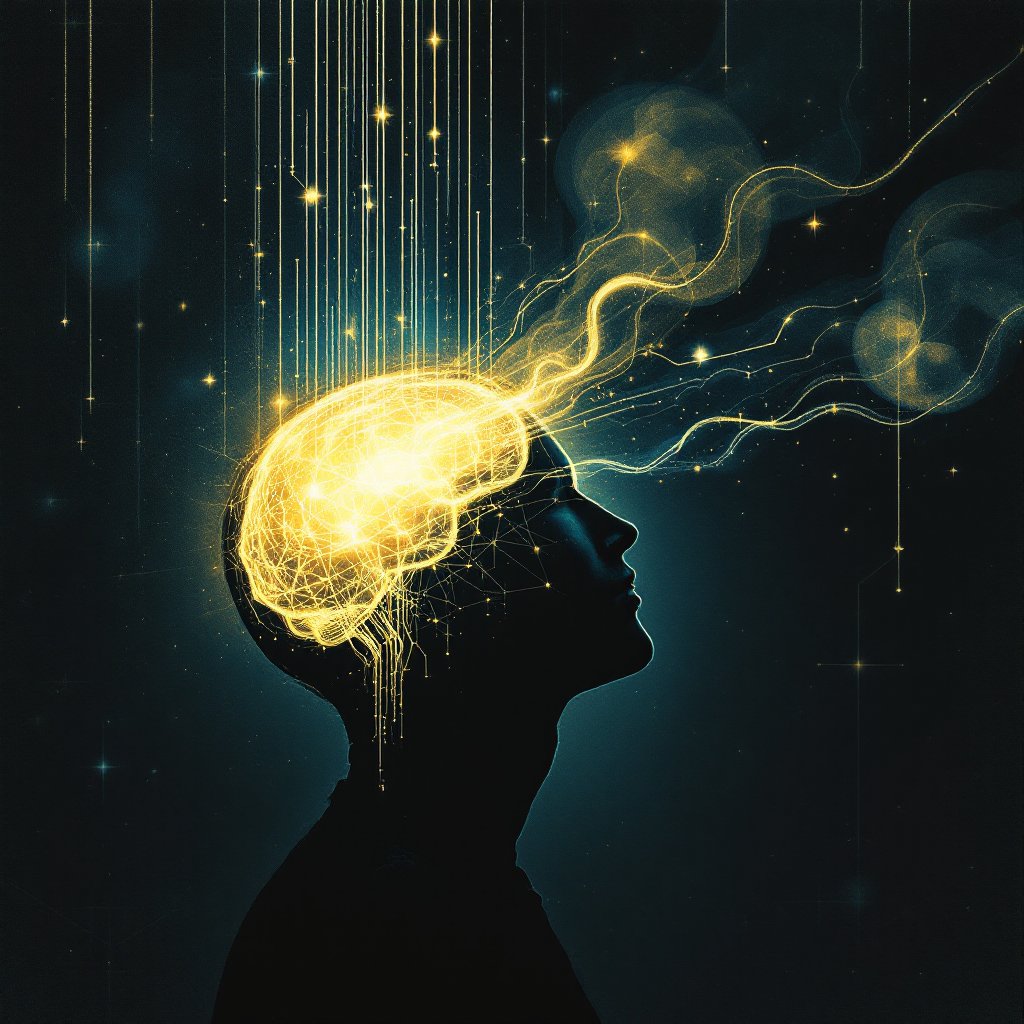
Confirmation bias explained: your mind is rigged to prove itself right. Not occasionally. Constantly. Every time you scroll, read, or listen, your brain is running a filter that keeps what confirms your worldview and discards what challenges it. This isn’t a character flaw. It’s a survival mechanism hardwired into your nervous system, one that kept your ancestors alive but now keeps you locked in a perception loop you didn’t choose and may not even recognize.
What makes confirmation bias so insidious is that it doesn’t feel like bias. It feels like clarity. The information that lands feels obvious, rational, true. The information that bounces off feels suspicious, agenda-driven, wrong. You’re not refusing evidence. Your brain is refusing to load it in the first place. By the time a conflicting idea reaches your conscious awareness, it’s already been tagged as threat rather than data.
This article maps the mechanism: what confirmation bias is, why evolution built it, how it operates at the neurological level, and what it costs you in sovereignty, relationships, and the ability to see reality as it actually is. More importantly, it offers the tools to recognize when the filter is running and how to override it before it collapses your perception into a single defended point.
What Confirmation Bias Actually Is
Confirmation bias is the brain’s tendency to search for, interpret, and remember information in ways that confirm preexisting beliefs. It’s not a conscious choice. It’s an automatic sorting mechanism that runs beneath awareness, determining what gets noticed, what gets dismissed, and what gets stored as memory.
Psychologist Peter Wason first documented the pattern in 1960 through a simple experiment. Subjects were given a sequence of three numbers and asked to discover the rule governing the sequence. They could test other sets of numbers, receiving feedback on whether each set fit the rule. Most participants formed a hypothesis early and then only tested examples that would confirm it, never testing cases that might disprove their theory. They believed they had discovered the rule when they had only confirmed their assumption.
That same pattern runs in your daily life. You form a belief, then your attention becomes a spotlight that only illuminates supporting evidence. Contradictory data doesn’t register as information worth considering. It registers as noise, distortion, or threat. This is why two people can witness the same event and leave with opposite interpretations. They aren’t lying. They genuinely perceived different realities, because their filters were set to different frequencies.
Confirmation bias operates across every domain: politics, health, relationships, science, religion, even self-perception. If you believe a person is untrustworthy, every ambiguous action gets interpreted as proof. If you believe a diet works, every positive fluctuation confirms it while every negative one gets explained away. The belief came first. The evidence arrived second, pre-sorted to fit.
Why Evolution Built the Filter
Your brain didn’t evolve to seek truth. It evolved to keep you alive. And in a survival context, speed beats accuracy every time. The ancestor who paused to weigh all evidence before deciding whether that rustling in the grass was wind or predator didn’t pass on their genes. The ancestor who assumed threat and ran survived, even if they were wrong 90% of the time.
Confirmation bias is an efficiency tool. The brain conserves energy by defaulting to patterns that already worked. When a belief has kept you safe, fed, or socially connected, questioning it feels dangerous. The nervous system reads uncertainty as instability, and instability as threat. So it doubles down on what it knows, even when what it knows is incomplete or wrong.
Research on cognitive biases shows this isn’t a bug in human cognition. It’s a feature. But a feature designed for a world that no longer exists. In the ancestral environment, the cost of a false positive was low. Run from wind? You’re fine. The cost of a false negative was death. Miss the predator? You’re gone. The system optimized for survival, not for discernment.
In the modern world, that same wiring becomes a trap. The threats aren’t predators. They’re complex, ambiguous, and require nuanced evaluation. Yet the brain still treats contradiction like danger. When someone challenges your political belief, your medical choice, or your identity, the same neural pathways light up as if you were under physical attack. fMRI studies confirm it: the brain regions that process social rejection and factual contradiction overlap with those that process pain.
To the nervous system, being wrong doesn’t feel like learning. It feels like dying. And so the mind defends. Not because you’re stubborn, but because your biology hasn’t caught up to the complexity of the world you’re navigating.
How Confirmation Bias Operates in Real Time
The filter runs in three phases: selective attention, biased interpretation, and selective memory. Each phase reinforces the others, creating a closed loop that becomes nearly impossible to escape without deliberate intervention.
Selective attention means you notice what confirms your belief and overlook what contradicts it. If you believe vaccines are dangerous, every adverse event story lands with weight. Every piece of safety data bounces off as propaganda. If you believe vaccines are safe, the opposite happens. Same information field. Opposite reception. The Reticular Activating System, the brain’s sensory gatekeeper, prioritizes what matches your expectations and filters out what doesn’t. You’re not refusing to see the other side. Your brain is refusing to show it to you.
Biased interpretation means ambiguous information gets read through the lens of existing belief. A politician’s statement can be interpreted as courageous honesty or blatant manipulation depending on whether you already support them. The words are the same. The meaning assigned is not. Psychologists call this motivated reasoning, the unconscious process where emotional investment in a belief drives how evidence is evaluated.
Selective memory means you recall supporting evidence more vividly and discard contradictory evidence faster. Studies show people remember wins that confirm their strategy and forget losses that challenge it. Entire conversations, facts, or experiences that don’t fit the narrative fade from memory or get rewritten to align with the belief. You’re not lying about the past. Your memory is editing it in real time.
Together, these three phases create what feels like certainty. But it’s not certainty. It’s coherence inside a closed system. You’ve built a reality where every input confirms the output, not because the system is accurate, but because it’s self-reinforcing.
The Cost of Running the Filter
Confirmation bias doesn’t just distort perception. It fragments relationships, collapses decision quality, and quietly erodes sovereignty. When the filter is running unchecked, you stop learning. You stop adapting. You become predictable, not because you’ve mastered yourself, but because you’ve locked yourself into a pattern you can’t see.
In relationships, confirmation bias turns partners into caricatures. If you believe your partner is selfish, every neutral action gets interpreted as proof. If you believe they’re loyal, red flags get explained away. Both distortions prevent you from seeing the person as they actually are. The relationship stops being between two people and becomes a projection loop where each person defends a story about the other.
In decision-making, confirmation bias collapses options. You only research the choice you’ve already made emotionally. Investors hold losing stocks because selling would mean admitting the investment thesis was wrong. Entrepreneurs ignore market signals because pivoting would mean the original vision failed. The bias isn’t protecting you. It’s protecting your ego from the discomfort of updating.
At the collective level, confirmation bias is the engine of polarization. People don’t just disagree anymore. They inhabit incompatible realities. Each side believes the other is brainwashed, malicious, or blind, never recognizing that both are running the same filter, just tuned to opposite frequencies. The divide isn’t ideological. It’s perceptual. And as long as both sides keep feeding their filters, the gap widens.
On suppression and distortion across institutions, the same mechanism operates at scale. Entire populations can be steered not by changing the facts, but by controlling which facts get amplified and which get buried. Confirmation bias ensures that once a narrative takes root, contradictory evidence won’t dislodge it. The system doesn’t need to silence dissent. It only needs to make dissent feel like noise.
The Illusion of Objectivity
The most dangerous feature of confirmation bias is that it’s invisible from the inside. You don’t experience it as a filter. You experience it as seeing clearly. The people who disagree with you? They’re biased. You? You’re just being rational.
Psychologists call this the bias blind spot: the inability to recognize bias in yourself even when you can easily spot it in others. In studies, people who scored high on measures of cognitive sophistication were more likely to exhibit confirmation bias on politically charged topics, not less. Intelligence doesn’t immunize you. It gives you better tools to rationalize what you already believe.
This is why simply knowing about confirmation bias doesn’t disable it. Awareness is necessary but not sufficient. The filter doesn’t run at the level of conscious thought. It runs at the level of perception, attention, and memory formation. By the time you’re thinking about an idea, the bias has already done its work. What reaches your conscious mind has already been pre-sorted.
The path out begins with a different question. Not “Am I right?” but “What would I need to see to know I was wrong?” If the answer is “nothing,” or if every hypothetical piece of contradictory evidence can be explained away, you’re not holding a belief. You’re defending an identity. And identity, once locked, becomes the cage.
How to Recognize When the Filter Is Running
The filter announces itself through specific patterns. Learn to recognize them, and you gain the ability to pause before the bias collapses your perception into a single defended point.
Pattern one: immediate emotional reaction to contradiction. If your first response to conflicting information is anger, dismissal, or the urge to argue, the filter is active. Truth doesn’t need defense. Only threatened identity does.
Pattern two: seeking evidence only after the conclusion. If you’ve already decided what’s true and you’re researching to prove it rather than test it, confirmation bias is driving. Real inquiry holds the question open. Biased inquiry closes it before the search begins.
Pattern three: explaining away every exception. If contradictory data always gets dismissed as flawed, biased, or irrelevant, you’re not evaluating evidence. You’re protecting a narrative. One exception might be noise. Ten exceptions is a pattern you’re refusing to see.
Pattern four: surrounding yourself only with agreement. If your media diet, social circle, and information sources all confirm the same worldview, you’re not seeking truth. You’re maintaining comfort. Environments without friction don’t sharpen discernment. They dull it.
Recognition is the first gate. The second is deliberate disconfirmation: the practice of actively seeking evidence that could prove you wrong. Not to tear yourself down, but to test whether what you believe can survive contact with reality. The full framework for overriding cognitive loops is detailed in Chapter 4 of Master Thyself, where the biological mechanism behind belief defense is mapped alongside the protocol for restoring perceptual flexibility.
The Stoic Antidote: Judgment Held Lightly
The Stoics understood confirmation bias long before psychology named it. Marcus Aurelius wrote: “Everything we hear is an opinion, not a fact. Everything we see is a perspective, not the truth.” That wasn’t relativism. It was precision. He knew the mind distorts, and the antidote is holding every judgment provisionally.
Epictetus taught that impressions pass through the mind automatically, but suffering begins when you give them approval. Thoughts arise. Beliefs surface. The Stoic doesn’t fight them. The Stoic withholds automatic consent. The filter can run. You don’t have to obey it.
This is the practice: when a belief feels certain, ask “Is this true, or does it just feel true?” When evidence contradicts what you want to believe, sit with the discomfort instead of explaining it away. When someone disagrees, assume they might see something you don’t rather than assuming they’re wrong. Not as a moral virtue. As a perceptual discipline.
The goal isn’t to eliminate bias. That’s not possible. The goal is to recognize it early enough to choose a different response. To see the filter running and decide, consciously, whether to let it collapse your perception or hold the field open a little longer.
Cognitive Dissonance: The Mechanism Behind the Defense
Confirmation bias doesn’t operate alone. It works in tandem with cognitive dissonance, the psychological discomfort that arises when conflicting beliefs or evidence collide. The brain treats dissonance as a problem to be solved, and the fastest solution is to reject the new information rather than update the old belief.
Leon Festinger’s 1957 study on cognitive dissonance remains one of psychology’s most revealing experiments. When a doomsday cult’s predicted apocalypse didn’t occur, members didn’t abandon their belief. They reinterpreted the failure as proof that their faith had saved the world. The dissonance between prophecy and reality was so uncomfortable that the mind rewrote the narrative rather than admit error.
You do this too. Every time you dismiss a valid critique because accepting it would mean rethinking a core belief, cognitive dissonance is the engine and confirmation bias is the outcome. The two mechanisms reinforce each other in a closed loop: dissonance creates discomfort, confirmation bias resolves it by filtering out the source of conflict, and the belief remains intact.
On perception and the architecture of simulated reality, this same dynamic operates at the civilizational scale. When the foundational narrative of a culture is challenged, entire populations experience collective dissonance. The response is predictable: double down, vilify the messenger, and reinforce the original story. The system doesn’t correct. It calcifies.
The Media Amplification Loop
Confirmation bias was always part of human cognition, but modern media has weaponized it. Algorithms don’t show you reality. They show you a mirror. Every click, like, and scroll trains the feed to show you more of what you already engage with. The result is a personalized echo chamber where your beliefs are continuously validated and opposing views are algorithmically suppressed.
This isn’t accidental. Engagement is the product. Outrage, validation, and tribalism drive engagement. Nuance, uncertainty, and complexity do not. The platforms profit when you stay inside the loop, so the architecture is designed to keep you there. Your confirmation bias becomes their business model.
What’s more insidious is that the curated feed feels like discovery. You think you’re exploring the internet. You’re being shown a narrow slice of it, pre-filtered to match what the algorithm predicts will keep you scrolling. The information you never see isn’t hidden by censorship. It’s hidden by irrelevance scoring. The system decided you wouldn’t engage with it, so it never loaded.
Breaking the loop requires manual override. Follow sources that challenge you. Read the other side’s best arguments, not their worst. Disable autoplay. Curate your feed like a temple, not a dopamine dispenser. The filter will always run. The question is whether you let it run on autopilot or take the wheel.
The Neurological Lock
Confirmation bias isn’t just psychological. It’s neurological. When a belief is challenged, the brain’s threat-detection system activates. The anterior cingulate cortex and amygdala light up, the same regions that process physical pain and danger. To the nervous system, contradiction doesn’t register as new information. It registers as attack.
This is why rational argument so rarely changes minds. You’re not arguing with someone’s reasoning. You’re triggering their defense system. The more evidence you present, the more threatened they feel, and the more their brain doubles down to protect the belief. What looks like stubbornness is often just a nervous system doing its job: defending coherence at all costs.
The way through isn’t more evidence. It’s safety. When the nervous system feels secure, the filter softens. When it feels attacked, the filter hardens. This is why people rarely change their minds mid-argument but often update their beliefs quietly, alone, when no one is watching. The social threat is gone. The nervous system stands down. And the new information finally has space to land.
Tools for Dismantling the Filter
Awareness starts the process. Practice completes it. The tools below don’t eliminate confirmation bias, but they weaken its grip enough to restore perceptual flexibility.
Steel-manning: Instead of arguing against the weakest version of the opposing view, construct the strongest version you can. If you can’t make their case convincingly, you don’t understand it well enough to dismiss it.
Premortem analysis: Before committing to a decision, imagine it failed. What went wrong? This forces you to consider risks and weaknesses your optimism bias would otherwise ignore.
Disconfirmation practice: Actively seek evidence that could prove you wrong. Not to tear yourself down, but to test whether your belief can survive contact with reality.
Source diversity: Consume information from across the spectrum. If every source you trust agrees with you, you’re not informed. You’re insulated.
Delayed judgment: When you encounter a claim that triggers immediate certainty, pause. Wait 24 hours before deciding. The emotional charge often fades, leaving clearer perception.
Cognitive empathy: Ask not just what someone believes, but why. What life experience, value system, or information set led them there? Understanding the path to a belief is often more useful than debating the belief itself.
None of these tools work if applied reactively. They must become discipline. The filter is always running. The only question is whether you notice it early enough to choose a different response.
The Sovereign Mind
Confirmation bias thrives in the reactive mind. It collapses in the sovereign one. Sovereignty means you are the author of your perception, not its prisoner. You recognize the filter, understand its purpose, and choose when to override it. Not because you’ve transcended biology, but because you’ve mastered the pause between stimulus and response.
The sovereign mind doesn’t eliminate bias. It observes bias without obeying it. It holds beliefs lightly enough to update them when reality demands. It treats certainty as a red flag rather than a destination. And it understands that the person who cannot change their mind has handed the wheel to a program they didn’t write and can’t see.
This is the work. Not to become unbiased, which is impossible, but to become aware, flexible, and capable of holding contradiction without collapsing into defense. The filter will always run. Mastery is what happens when you stop letting it drive.
Closing Reflection
Confirmation bias explained: your mind is wired to defend what it already believes, not because you’re flawed, but because survival required speed over accuracy. In the modern world, that same wiring becomes a trap. It collapses perception, fragments relationships, and ensures you keep seeing the world you expect rather than the world as it is.
The antidote isn’t more intelligence. It’s more humility. The willingness to sit with uncertainty. The discipline to seek disconfirmation rather than validation. The courage to recognize that what feels true might only feel familiar. And the sovereignty to hold your beliefs lightly enough that reality can update them without breaking you.
The filter is always running. The only question is whether you notice it early enough to choose a different response. That pause, that breath, that moment of recognition before reaction, is where freedom lives. Not in the absence of bias, but in the conscious choice not to obey it.