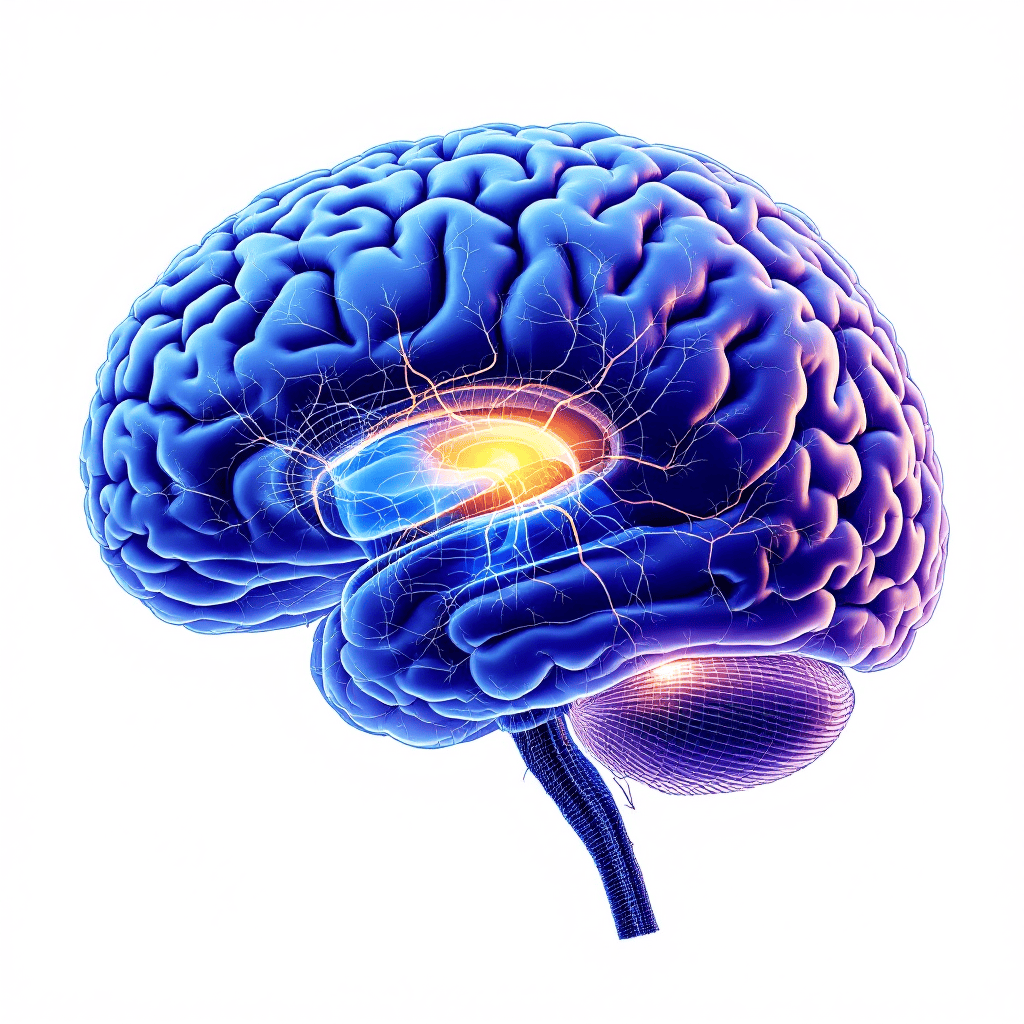
What is the default mode network? It’s the brain pattern that activates when you’re not focused on the outside world, when your mind wanders, when you daydream, replay conversations, or plan the future. Neuroscientists call it the DMN. Ancient traditions called it the monkey mind, the ego, or the veil. Same mechanism. Different names.
The default mode network isn’t a single structure. It’s a connected system of brain regions that fire together when you’re not doing anything in particular. The medial prefrontal cortex (the area behind your forehead), the posterior cingulate cortex (deep in the center), and the angular gyrus (on the sides) all light up when you’re thinking about yourself, your past, your identity, or your future. This network is where the sense of “I” lives. It’s where your story about who you are gets written and rewritten thousands of times a day.
And here’s the problem: for most people, it never shuts off.
The Brain Pattern That Never Rests
The default mode network was first identified in 2001 by neuroscientist Marcus Raichle at Washington University. He noticed something strange: when people were given a task to focus on, certain brain regions quieted down. When the task ended and their minds wandered, those same regions became more active. The pattern was so consistent across subjects that it couldn’t be random. The brain wasn’t resting during these moments. It was running a specific program.
That program is self-referential thought. The default mode network is constantly asking: What does this mean for me? How do I look? What do they think of me? What happened yesterday? What might happen tomorrow? It’s the narrator inside your head that never stops talking. And the more it talks, the more you believe the story is you.
Research published in the journal Neuron shows that people spend roughly 47% of their waking hours with their minds wandering. That’s nearly half your life spent inside a mental simulation instead of present in the moment. The default mode network is the engine of that simulation. It keeps you thinking about yourself even when there’s no reason to.
Why the Default Mode Network Keeps You Trapped
The default mode network isn’t inherently bad. It allows you to remember the past, plan for the future, and imagine scenarios. These are useful functions. But when the DMN dominates, it becomes a prison. You stop experiencing life directly and start filtering everything through the lens of self. Every event becomes about you. Every interaction gets replayed and analyzed. Every mistake gets rehearsed until it feels like identity.
This is where ego lives. Not as a personality trait, but as a biological pattern. The default mode network is the hardware that runs the ego’s software. When you’re defensive, anxious, or trapped in loops of shame and self-judgment, the DMN is firing. When you’re ruminating on a conversation from three days ago or rehearsing what you’ll say tomorrow, the DMN is active. The more time you spend there, the more rigid your sense of self becomes.
And the system learns. Neuroscience calls this neuroplasticity: the brain physically rewires itself based on repeated patterns. If you spend years reinforcing the same mental loops, those pathways become highways. The default mode network gets stronger, faster, and harder to interrupt. What started as a survival tool becomes an autopilot that hijacks your attention and keeps you locked in a story that may not even be true.
This is why ego dissolution and inner sovereignty require more than insight. They require interrupting the default mode network at the biological level.
Meditation and the Quieting of the DMN
Here’s what changes everything: meditation quiets the default mode network. Brain imaging studies show that experienced meditators have significantly reduced activity in the DMN during practice. The regions that normally fire together when you’re thinking about yourself fall silent. The narrative stops. The story dissolves. What remains is awareness without the constant self-reference.
This isn’t just relaxation. It’s a state shift. When the default mode network quiets, other brain networks activate. The salience network, which governs attention and present-moment awareness, comes online. The executive control network, which handles focus and decision-making, stabilizes. The brain stops running on autopilot and starts operating from clarity.
Buddhist monks who have spent tens of thousands of hours in meditation show permanent changes in DMN activity. Even when they’re not meditating, their default mode network fires less intensely than the average person’s. They’ve trained the brain to spend less time in self-referential loops and more time in direct experience. That’s not a mystical state. That’s measurable brain function.
But you don’t need 10,000 hours to see results. Studies show that even eight weeks of mindfulness practice reduces DMN activity and increases connectivity between brain regions associated with attention and emotional regulation. The change is real, and it’s accessible.
Psychedelics and DMN Disruption
Psilocybin, the active compound in magic mushrooms, does something remarkable to the default mode network: it temporarily shuts it down. Research from Imperial College London using fMRI scans showed that psilocybin dramatically reduces activity in the DMN, particularly in the posterior cingulate cortex, one of the network’s core hubs. When that happens, the rigid sense of self dissolves. People report feeling connected to everything, losing the boundary between “me” and “not me,” and experiencing a state of pure awareness without the constant mental chatter.
This is why psychedelics are being studied for depression, anxiety, and PTSD. These conditions are often characterized by an overactive default mode network, a mind trapped in loops of rumination, self-criticism, and fear. By disrupting those loops, psilocybin creates a window where the brain can reorganize itself. The narrative that felt permanent suddenly becomes optional.
The same effect has been observed with other substances that alter consciousness, including DMT and LSD. All of them share a common mechanism: they quiet the default mode network and allow other patterns of brain activity to emerge. This isn’t escape. It’s a reset. The question is whether that reset lasts, and that depends on what you do after the experience.
The Ego as Adaptive AI
The default mode network behaves less like a soul and more like adaptive artificial intelligence. It predicts threats, builds narrative continuity, defends identity, optimizes survival and status, and runs scripts based on past data. Neuroscience shows that decisions begin before conscious awareness, and the mind backfills explanations afterward. Personality is largely pattern reinforcement. What feels like “you” is often pattern execution running through the default mode network.
In simulation terms, the ego functions as the local operating layer that allows your avatar to move through the environment. It’s not the player. It’s the interface. And when the interface believes it’s the player, every threat to the story feels like a threat to existence itself. That’s why people defend their beliefs with such intensity. The default mode network has fused identity with narrative, and questioning the narrative feels like annihilation.
This is the trap. The default mode network was built to help you navigate the world, but it ended up building a cage. The way out isn’t through more thinking. It’s through less. The way out is silence.
Fasting, Breathwork, and DMN Regulation
Fasting doesn’t just reset the body. It quiets the default mode network. When insulin drops and ketosis begins, brain chemistry shifts. The constant mental chatter that normally dominates waking life starts to thin. Practitioners report clarity, presence, and a reduction in compulsive thought. That’s not willpower. That’s biology.
The same effect occurs with breathwork. Slow, rhythmic breathing activates the vagus nerve and shifts the nervous system out of threat mode. When the body registers safety, the default mode network releases its grip. The mind stops scanning for problems and settles into presence. Breath is the fastest access point to nervous system regulation, and nervous system regulation is what allows the DMN to finally rest.
The protocol isn’t complex. Five seconds in, five seconds out. Sustained for several minutes. That’s coherent breathing, and it directly downgrades DMN activity while strengthening attention networks. Combine that with fasting during the lunar or follicular window, and you’re not just managing the default mode network. You’re retraining it.
The complete framework for DMN regulation through fasting, breathwork, and timing is detailed in Chapter 22 of Master Thyself, where the biological reset meets the spiritual path. What’s redacted there isn’t theory. It’s REDACTED, READ CHAPTER 22.
The DMN and Emotional Contagion
The default mode network doesn’t just shape your inner experience. It shapes the field around you. When the DMN is overactive, the emotional state it generates radiates outward. Anxiety, defensiveness, and self-absorption are contagious. Mirror neurons in the people around you pick up the signal and begin to synchronize. One anxious person in a calm room shifts the room’s baseline. That’s not metaphor. That’s measurable biology and energetic resonance.
Conversely, when the default mode network quiets and coherence stabilizes, the signal you broadcast changes. Calm becomes contagious. Presence becomes magnetic. People feel safer around you without knowing why. The nervous system reads coherence as safety, and safety is what allows others to drop their own DMN loops.
This is the mechanism behind what mystics called transmission. It’s not magic. It’s physiology. A coherent heart generates an electromagnetic field that extends several feet in every direction. When your default mode network is quiet and your heart is coherent, you’re not just changing your own state. You’re influencing everyone within range.
Theta States and the DMN Gate
The default mode network operates most strongly in beta brainwave states, the waking, reactive, problem-solving mode most people live in. But when the brain shifts into theta, between 4 and 7 Hz, the DMN loses its grip. Theta is the threshold state between waking and sleep, the zone where imagination becomes vivid and the critical filter softens. This is when the subconscious becomes accessible.
The most reliable natural access to theta is the first 10 to 15 minutes after waking and the period just before sleep. In these windows, the default mode network hasn’t fully engaged yet, or it’s beginning to release. What you imprint here shapes your day and your dreams disproportionately. This is why ancient traditions placed prayer at dawn and dusk. They knew something neuroscience is only now confirming: timing determines depth of imprint.
Chanting, mantra repetition, and rhythmic breathwork all induce theta states by overwhelming the default mode network with a single, repetitive input. The mind stops generating its usual narrative and entrains to the rhythm instead. The DMN quiets not through force, but through pattern replacement and biological timing. That’s the mechanism behind every contemplative practice from Gregorian chant to Sufi dhikr to yogic pranayama. Different doors. Same room.
Why the Architects Fear a Quiet DMN
A population with an overactive default mode network is a manageable population. When people are trapped in self-referential loops, constantly defending identity, replaying trauma, and rehearsing fear, they’re not asking deeper questions. They’re not building coherence. They’re not threatening the systems that benefit from their fragmentation.
This is why media, social platforms, and outrage cycles are so effective. They keep the default mode network firing. Every notification is a micro-identity threat. Every headline is a reason to defend your position. Every scroll is a dopamine hit that reinforces the loop. The DMN stays active, the ego stays defended, and sovereignty remains out of reach.
The opposite is also true. A person with a quiet default mode network is ungovernable. They don’t react to bait. They don’t defend positions they didn’t consciously choose. They don’t need external validation because the internal narrator has finally gone silent. That silence is the beginning of real freedom.
This is why every tradition that taught inner mastery also taught practices to quiet the mind. Not as a side effect. As the primary goal. The suppression of these practices wasn’t accidental. It was architectural. A quiet mind sees through the illusion. And that’s the one thing the system cannot afford.
How to Reclaim Your Attention
Interrupting the default mode network isn’t about thinking differently. It’s about thinking less. The practices are simple, but they require consistency:
Meditation trains the brain to recognize when the DMN has activated and to return to presence without judgment. Even 10 minutes daily rewires the pathways. Breathwork shifts the nervous system out of reactivity, allowing the DMN to release its grip. Fasting removes the metabolic noise that keeps the mind churning. Theta-state prayer during the dawn or pre-sleep window imprints intention when the gate is open. Digital fasting removes the constant stimulation that keeps the DMN locked in defense mode.
None of these are optional if sovereignty is the goal. The default mode network will not release voluntarily. It must be trained, interrupted, and eventually transcended. The ego doesn’t die. It learns its place. And when it finally steps aside, what remains is presence, clarity, and the quiet awareness that was always there beneath the noise.
The default mode network is the last gatekeeper. It’s the pattern that convinces you the story is you. But the story was never you. You are what’s aware of the story. And the moment you recognize that, the gate opens.
Closing Reflections
What is the default mode network? It’s the ego’s operating system. It’s the voice that narrates your life, defends your identity, and keeps you locked in loops of self-reference. It’s the reason you can’t stay present. It’s the mechanism behind rumination, anxiety, and the endless rehearsal of past and future. And it’s the single most important brain pattern to understand if you want to reclaim your sovereignty.
The system doesn’t fear your anger. It fears your silence. A quiet default mode network is a liberated mind. And a liberated mind cannot be controlled.
The gate is real. The path is biological. And the work begins the moment you stop believing the narrator is you.