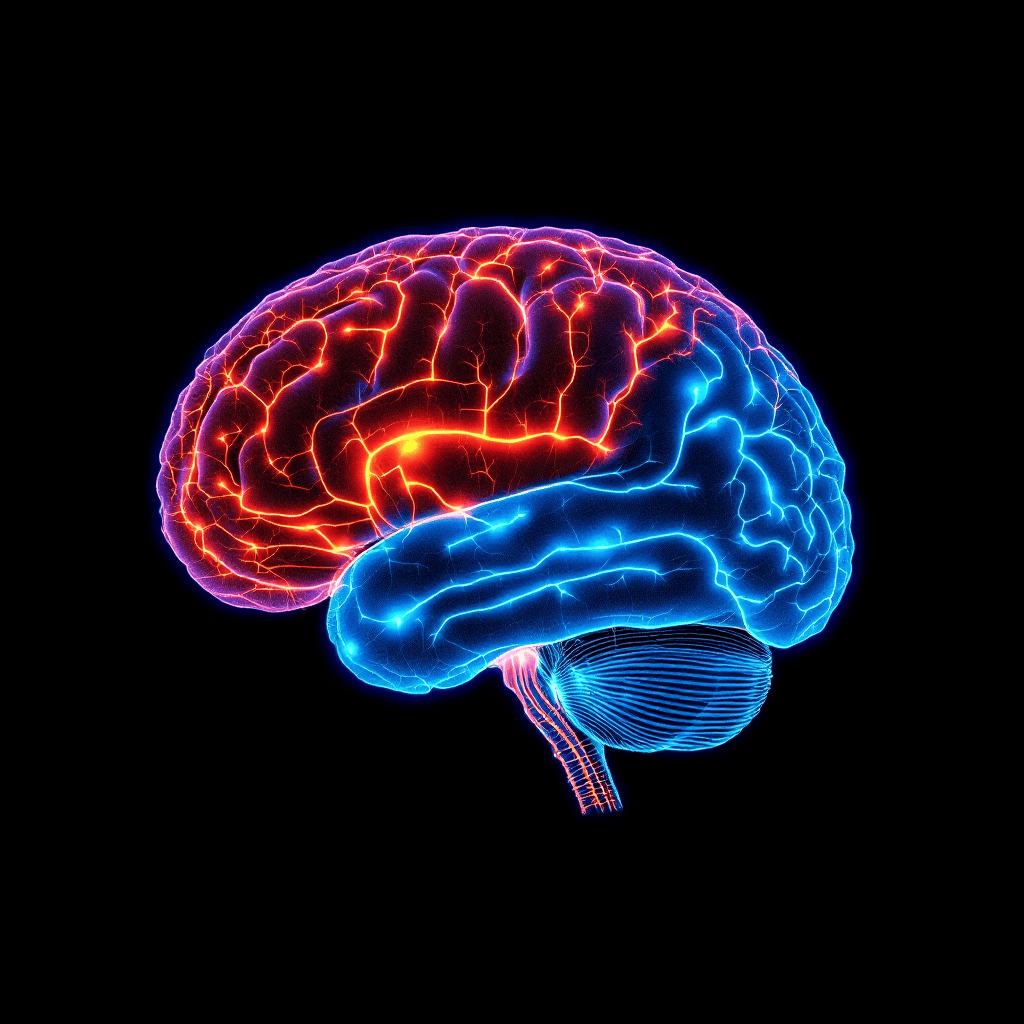
Survival mode brain explained begins with a single truth: your brain was not designed to pursue clarity, presence, or enlightenment. It evolved to detect threats, resolve urgency, and preserve survival. For most of human history, that system activated briefly when danger appeared, then shut off. Today, it never shuts off. The default state of the modern nervous system is low-grade survival signaling, not panic or terror, just enough unresolved tension to keep attention fragmented, the body braced, and the mind reactive.
This is the mechanism most people spend their lives inside without ever naming it. The survival mode brain is not a character flaw or a sign of weakness. It is a biological response to environmental pressure that has become chronic. What was once protective has become destructive, and what was designed to save your life now quietly prevents you from living it fully.
What Survival Mode Actually Means
When the nervous system perceives threat, real or imagined, it prioritizes speed over accuracy, reaction over reflection, short-term certainty over long-term coherence. The brain stops integrating information across systems. It narrows focus. It amplifies emotion. It suppresses higher-order reasoning. The ladder that leads upward cannot be climbed from inside a survival loop.
The autonomic nervous system governs this response automatically, shifting between parasympathetic rest and sympathetic activation. When sympathetic dominance becomes chronic, the body remains in a state of preparedness that was never meant to be sustained. Cortisol stays elevated. Digestion slows. Immune function suppresses. Perception narrows to the immediate environment, scanning for danger that may not exist.
This is why clarity disappears under pressure. This is why intention fails under stress. This is why people know better yet still react, overconsume, self-sabotage, and chase comfort. The mind doesn’t default to truth. It defaults to relief. Anything that promises relief becomes attractive: food, stimulation, outrage, entertainment, social media, drugs, politics, alcohol, noise. These aren’t character flaws. They are regulatory attempts by a system seeking safety.
The Biology of Fragmentation
In survival mode, the prefrontal cortex, the region responsible for executive function, planning, and impulse control, becomes partially suppressed. Blood flow redirects to the amygdala, the brain’s threat-detection center, and to the brainstem, which governs reflexive action. This is efficient for escaping a predator. It is catastrophic for navigating modern life.
The amygdala cannot distinguish between a physical threat and a perceived one. A harsh email, a financial worry, or a social slight can trigger the same cascade as a charging animal. The body floods with adrenaline and cortisol. Heart rate spikes. Breathing shallows. Muscles tense. The system prepares to fight, flee, or freeze, but there is no predator to fight, no danger to escape, and no resolution available. The activation lingers.
Over time, this chronic activation rewires the brain. Neural pathways associated with threat become stronger and more automatic. The nervous system becomes hypervigilant, interpreting neutral stimuli as dangerous. A person in chronic survival mode begins to expect threat everywhere, and the brain obligingly finds it. This is not paranoia. It is pattern reinforcement. What you practice, you become, and survival mode is a practice repeated thousands of times per day.
Why Modern Life Keeps You Trapped
The architects of modern culture understand survival mode brain explained at a level most people never reach. They don’t need to chain you. They only need to keep the survival program running. A population locked in survival mode never reaches for the controller. The masses aren’t broken. They are managed.
Every system of control described in the study of ego dissolution and inner sovereignty functions by exploiting this biological vulnerability. Processed food suppresses pineal function. Fluoride calcifies it. Engineered news cycles keep cortisol elevated. Social division prevents coherent community. Screen overstimulation blocks theta brainwave states. Each one is individually defensible as convenience or progress. Together, they form an architecture.
Consider the modern media environment. News networks operate on a 24-hour cycle of breaking alerts, each framed as urgent and threatening. The brain registers each alert as a survival signal. Outrage becomes addictive because it delivers a dopamine spike paired with adrenaline, creating the illusion of action without requiring any. Scrolling through social media triggers micro-doses of the same response hundreds of times per session. The nervous system never rests.
Economic pressure functions the same way. When survival anxiety takes root, spiritual aspiration withers. The daily choice stops being between good and evil and becomes rent or groceries. Higher callings, the desire to create, to serve, to contemplate, are drowned out by the hum of financial worry. This is not accidental. A person locked in survival mode has no bandwidth for questioning the system that keeps them there.
What Happens to Perception
When the survival mode brain dominates, perception collapses. The expansive awareness that can hold paradox, recognize pattern, and integrate complexity becomes inaccessible. In its place, a narrow beam of attention scanning only for threat and opportunity. Nuance disappears. Every situation becomes binary: safe or dangerous, ally or enemy, win or lose.
This is the state most people call normal. They have lived inside it so long they believe it is simply how consciousness works. But it is not consciousness. It is consciousness compressed, filtered through a nervous system that believes it is always thirty seconds from death.
The loss is not only perceptual. It is relational. A person in chronic survival mode cannot form deep connection because connection requires vulnerability, and vulnerability feels like death to a system on high alert. Intimacy becomes transactional. Trust becomes conditional. Love becomes a resource to be managed rather than a state to be inhabited. The collapse of perception produces the collapse of relationship, which reinforces isolation, which deepens the survival response. The loop closes.
The Trapped Mind Cannot Recognize the Trap
One of the most insidious features of survival mode is that it prevents the recognition of itself. When the prefrontal cortex is suppressed and the amygdala dominates, the capacity for self-reflection diminishes. The person inside the state cannot see the state. They believe their reactivity is justified, their anxiety is rational, their perception is accurate. The system defends itself by making its own distortion invisible.
This is why external intervention rarely works. Telling someone in survival mode to calm down, think rationally, or see the bigger picture is functionally useless. The brain regions required to process that advice are offline. The instruction doesn’t land. Worse, it can trigger defensiveness, because challenge feels like attack when the nervous system is primed for threat.
The way out is not through argument or insight delivered from outside. It is through biological regulation and rhythmic restoration that quiets the survival signal long enough for higher function to return. Only when the nervous system registers safety can the prefrontal cortex come back online. Only then does the person become capable of seeing the pattern they were trapped inside.
The Default Mode Network and Ego Reinforcement
The brain’s default mode network, a set of regions active during rest and self-referential thought, plays a critical role in survival mode. When the nervous system is chronically activated, the default mode network becomes hyperactive, producing a constant stream of internal narrative: planning, worrying, rehearsing, defending. This is the voice most people mistake for themselves.
The stream is not neutral. It is biased toward threat detection and self-protection. It scans memory for evidence of danger. It projects fear into the future. It reinforces the belief that the self is separate, vulnerable, and must be defended at all costs. This is the ego in survival mode, and it is exhausting.
Meditation research has shown that quieting the default mode network produces states of expanded awareness, present-moment clarity, and reduced self-referential thought. Survival mode does the opposite. It amplifies the network until the internal narrative becomes louder than reality itself. The person stops responding to what is happening and starts responding to the story about what is happening. The map replaces the territory.
Breaking the Loop
Survival mode brain explained would be incomplete without the path out. The loop can be broken, but it requires intervention at the level of the nervous system, not the mind. Thought alone cannot override a survival signal. The body must be convinced that it is safe before the brain will release its grip.
Breathwork is the fastest access point. Slow, rhythmic breathing, specifically five seconds in and five seconds out, directly activates the vagus nerve, the primary safety signal in the body. When the vagus fires, the parasympathetic nervous system engages. The heart rate slows. Cortisol drops. The prefrontal cortex comes back online. Coherence returns. This is not a metaphor. It is measurable physiology, and it can shift the system in minutes.
Fasting provides a deeper reset. When the body enters ketosis and autophagy, the hormonal cascade changes. Insulin drops. Growth hormone rises. Inflammation decreases. The nervous system, no longer managing the metabolic load of constant digestion, has bandwidth to regulate itself. The survival signal quiets not through force but through the body’s recognition that it has resources, that it is not starving, that it is safe. The three-day cycle described in the complete framework of self-mastery is not spiritual theater. It is biological recalibration.
Grounding and nature exposure provide environmental regulation. The body’s electromagnetic field synchronizes with the Earth’s when bare skin contacts the ground. Cortisol levels drop measurably after twenty minutes of grounding. Sunlight resets circadian rhythm, which governs the entire endocrine system. These are not wellness trends. They are evolutionary anchors, signals the nervous system was built to receive and has been deprived of in modern life.
The Role of Emotional Sovereignty
Survival mode teaches learned helplessness. It convinces the person that their emotional state is determined by external events, that other people make them feel things, that circumstances control their inner world. This is the most persistent lie the survival brain tells, and it is also the most disempowering.
Emotional sovereignty begins with the recognition that no one makes you feel anything. Emotions are signals generated internally in response to interpretation. The event is neutral. The meaning you assign creates the feeling. Change the meaning, and the feeling changes. This is not denial or spiritual bypassing. It is the restoration of inner authority and balanced response.
Between stimulus and response, there is a space. In that space is the power to choose. Survival mode collapses that space to nothing, producing reflex where choice should be. The practice of mastery is widening that space until response becomes conscious again. The person who can pause between trigger and reaction is no longer governed by survival mode. They have stepped outside the loop.
Coherence as the Antidote
The opposite of survival mode is not relaxation or passivity. It is coherence. Coherence is the state in which heart, brain, and body synchronize, producing smooth, ordered rhythms across the nervous system. In this state, perception expands. Pattern recognition sharpens. Decision-making clarifies. Energy stabilizes. The person becomes capable of holding complexity without collapsing into reactivity.
Coherence cannot be forced. It arises when interference is removed. Survival mode is interference. Remove the chronic activation, regulate the nervous system, and coherence emerges naturally. This is not a skill to be learned. It is a default state to be restored.
The HeartMath Institute has documented this extensively. A heart in coherence generates a smooth sine-wave pattern in heart rate variability. A heart in survival mode generates a jagged, erratic pattern. The coherent heart broadcasts an electromagnetic field that can be measured several feet away. The incoherent heart radiates noise. Coherence is not only an internal experience. It is a transmission that affects everyone nearby.
The Architects Know What You Don’t
What makes survival mode so effective as a control mechanism is that it is self-sustaining. Once established, it requires no external enforcement. The person enforces it themselves through habit, belief, and nervous system conditioning. They scroll the feed that agitates them. They consume the news that terrifies them. They repeat the internal narrative that keeps them small. The cage is invisible because the bars are inside.
The Architects of Control, as described throughout the suppression patterns and distorted doctrines, do not need to micromanage a population in survival mode. They only need to maintain the conditions that produce it. Keep the food supply toxic. Keep the information environment chaotic. Keep economic pressure constant. Keep social cohesion fractured. The biology does the rest.
This is not a conspiracy in the traditional sense. It is a convergence of interests that all benefit from a population that cannot think clearly, cannot organize effectively, and cannot access the states of consciousness that would allow them to see the game. Survival mode is the game. Everything else is distraction.
Mastery Begins with Recognition
You cannot exit a state you do not recognize. The first step is not breath or fasting or meditation. The first step is naming the condition. I am in survival mode. My nervous system believes it is under threat. My perception is narrowed. My reactions are automatic. This is not who I am. This is a state I am in.
That recognition is the crack in the wall. Once named, the state loses some of its grip. The person begins to notice the pattern: the triggers, the collapse, the narrowing, the reactivity. They begin to see the loop from outside the loop. And once seen, the loop can be interrupted.
Mastery is not perfection. It is the speed of return. The coherent person still experiences stress, fear, and activation. What changes is how quickly they recognize it and how effectively they regulate back to baseline. Fall, notice, breathe, reset. Repeat until coherence becomes the default instead of the exception.
The Path Forward
Survival mode brain explained is not a diagnosis of hopelessness. It is a map to the exit. The nervous system is trainable. Neural pathways are plastic. Hormonal balance is recoverable. Coherence is always available, waiting beneath the noise.
The practices are simple but not easy. Breathwork. Fasting. Grounding. Stillness. Emotional sovereignty. Conscious input. These are not additions to an already full life. They are the removal of interference so that life can be lived fully. The person who masters these tools is no longer managed by external forces. They become ungovernable, not through rebellion, but through self-regulation.
This is the work. Not to escape the world, but to stop being controlled by it. Not to transcend the body, but to restore it to the state it was designed to inhabit. Not to fight survival mode, but to recognize it, regulate it, and return to coherence so consistently that coherence becomes home.
The gate is always open. The question is whether you will stop running long enough to walk through it.